Gain the storytelling clarity you seek by having all your notes in one connected system — Meet the Storyteller OS.

The Two-Attribute Framework for Building Memorable, Theme-Driven Heroes
The most tragic backstory can still fall flat. Two attributes matter more than any origin story.

Written by Kevin Barrett
share




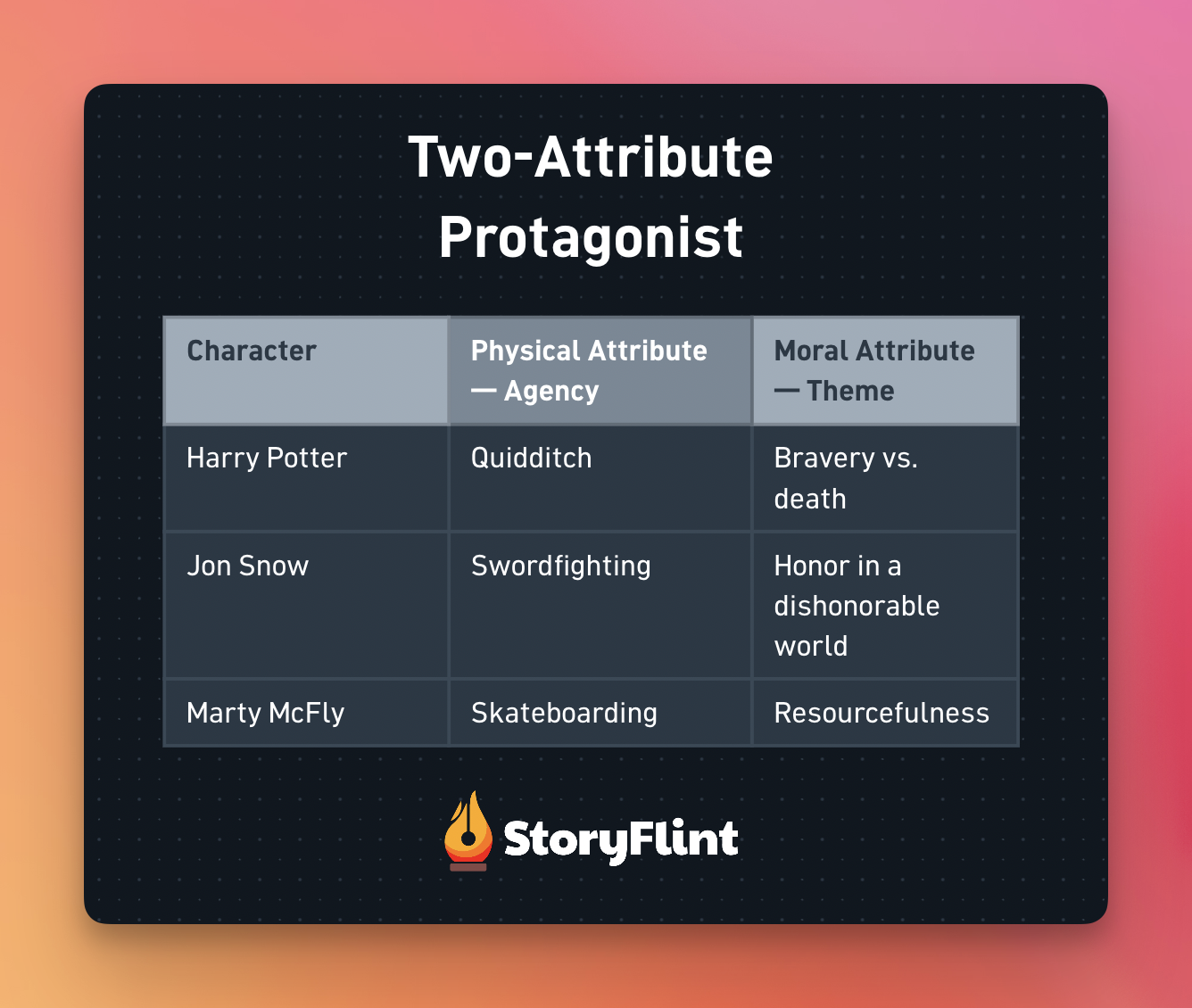
Two Attribute Hero Model: A memorable protagonist has two superior traits: a physical ability that outclasses most characters around them, and a personality trait that aligns with the story's central theme.
🔥 Why this guide exists
No mind was built to hold an entire novel at once. StoryFlint turns the chaos in your head into a story you can see and control — frameworks to order your thinking, and the Storyteller OS to order your project. Bring us the mess.
share
Backstory is overrated.
There. I said it.
I've been pulling protagonists apart for years, and the same pattern keeps showing up. You can give your hero the most tragic origin in fiction and they'll still feel forgettable if they fail one specific test. The protagonists that actually stick (Harry Potter, Jon Snow, Marty McFly) all share something specific. It's not the wound. It's two attributes they carry into every scene.
The Two Attributes
A memorable protagonist has two superior traits: a physical ability that outclasses most characters around them, and a personality trait that aligns with the story's central theme.
Both are required. The physical attribute is what lets them act on the story instead of having things happen to them. The moral attribute is what they prove. They become the living evidence of whatever the story is arguing is true about the world.
A quick clarification, because this is where the framework gets misread: "physical" doesn't mean combat. It means a concrete, external competence that lets your character do something the people around them can't. A doctor's training counts. So does a blacksmith's. So does knowing how pirates think. If your hero is a lawyer who outmaneuvers everyone in the courtroom, that's the attribute. The point isn't muscle — it's agency.
Good news for anyone whose hero couldn't win a fistfight with a coat rack.
Take Harry Potter. The kid can outfly anyone on a broomstick, and he's the one character who keeps walking toward death while everyone else runs from it. Death is, conveniently, the entire thematic spine of the series.
Jon Snow can outduel almost anyone with a sword. And in a world where every other character trades honor for survival without flinching, he refuses to. That refusal is the whole show.
Without both, your character ends up passive or thematically empty. With both, they feel inevitable.
Why the Physical Attribute Matters
As Matt Bird puts it in The Secrets of Story, audiences prefer heroes who solve second-act problems with first-act skills.
In The Fugitive, Harrison Ford is a doctor, so he spends the entire film slipping in and out of hospitals. In Back to the Future, Marty has nothing but skateboarding and rock guitar, so he invents both in 1955 just to save himself. In Pirates of the Caribbean, Will Turner's blacksmithing becomes a tool for survival.
The physical attribute isn't decoration. It's the engine that lets your hero act on the story instead of getting dragged through it.
📖 Why the Best Characters Solve Problems Like Specialists, Not Geniuses — How narrow, real-world expertise beats generic brilliance when designing a protagonist who has to act on the page.
Why the Moral Attribute Carries the Theme
As Matt Bird's The Secrets of Story explains, heroes prove uniqueness by responding the way no Everyman would.
Will Smith drags the table over while every other Men in Black candidate tries to balance the form on their lap.
Scrawny Steve Rogers jumps on a grenade.
In Margin Call, Zachary Quinto is the only analyst who bothers to say a heartfelt goodbye to a fired colleague. That single act of compassion earns him the warning that saves him.
Each one is a one-sentence argument about what the story believes is true.
📖 Using Theme to Create Character — A repeatable method for designing protagonists whose values and contradictions argue the theme of your story.
The Pattern in Famous Protagonists
Once you see this pattern, you can't unsee it. It's a magic trick that gets better when you know the secret — every protagonist suddenly shows you their hands.
Katniss Everdeen (The Hunger Games)
Years of hunting to keep her family alive in District 12 made her dangerous with a bow.
What makes her Katniss, though, is how fiercely she protects innocents: volunteering for Prim, mourning Rue on camera, refusing to play the role the Capitol wants.
Spectacle versus humanity is the trilogy's theme. Katniss doesn't win because she's the deadliest tribute. She wins because she's the only one who never stops seeing the other tributes as people.
Aragorn (The Lord of the Rings)
Decades as a Ranger left him with swordsmanship and tracking that nobody else in Middle-earth can match.
What sets him apart morally is that he doesn't actually want the throne. He spends three movies (or half of the first book) trying to refuse the responsibility he was born into. The trilogy's whole argument is that power corrupts the people who reach for it.
He gets offered the Ring twice. Refuses both times. That's what earns him the crown, not the bloodline. The restraint.
In a genre packed with chosen ones sprinting toward the nearest throne, not wanting it is practically a superpower.
Ellen Ripley (Alien)
She knows the Nostromo's mechanics, protocols, and airlocks better than anyone left alive on the ship. That's the kind of advantage nobody respects until you watch her flush an alien out an airlock.
The moral piece is harder to name and easier to feel. She refuses to treat human life as inventory, which is exactly what the Company is built to do. She also refuses to leave the cat behind. Both, in the same scene.
Run the Test
Before your next chapter, ask two questions:
- What physical ability does your protagonist have that most characters around them don't?
- What moral or personality trait do they have that lines up with the theme?
If either answer is "nothing specific," you don't have a character problem. You have a structure problem.
Yeah, that one stings. But it's also fixable.
Backstory Was Never the Answer
We're trained to believe a great hero starts with a great wound — the dead parents, the tragic origin, the scar they carry into act one. But the wound is just context. What makes Harry, Jon, Katniss, and Ripley feel inevitable is the pair of attributes they carry into every scene: one that lets them act, and one that proves what the story believes is true.
So before you draft your protagonist's tragic past, write their two attributes first. Give them one skill that earns them agency and one trait that carries your theme. Get those right, and the backstory stops being a crutch and starts being a bonus.
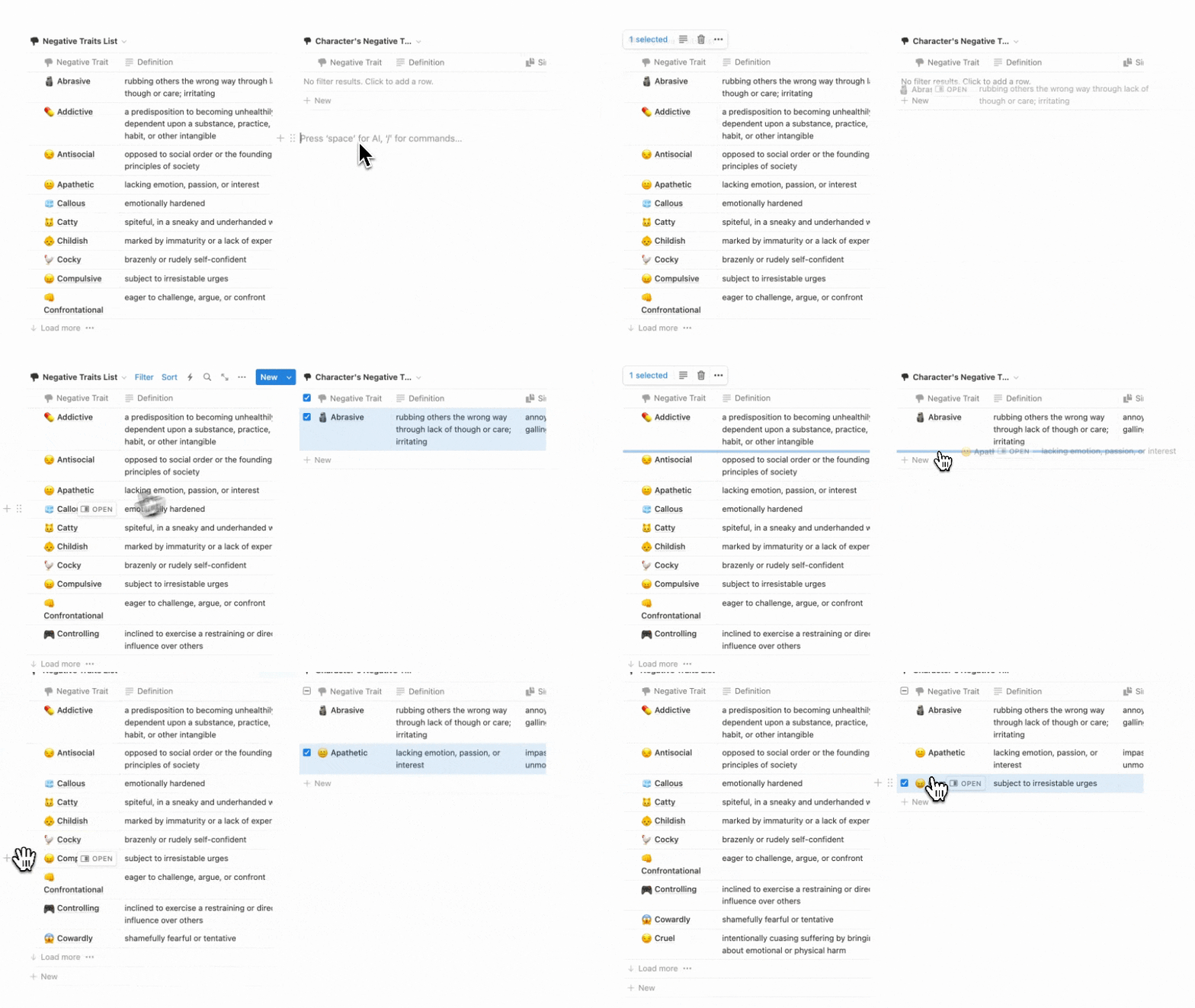
Designing one protagonist this way is hard enough. Doing it for every character in your story — and tracking how those two attributes shift, deepen, and collide across a draft — is where most writers lose the thread.
Characters are the heart of every story, but holding all of that in your head, scene after scene, is its own full-time job. Every character deserves the same two-attribute design work you just gave your hero, plus a place to track how those attributes change as the story tests them. The Storyteller OS gives every character their own space, where physical attributes, moral attributes, motivations, arcs, and the relationships between them all stay connected.
See how Storyteller OS handles a full cast.
For the full walkthrough: How I Used Notion to Build the Ultimate Storytelling System.
Contents