Gain the storytelling clarity you seek by having all your notes in one connected system — Meet the Storyteller OS.

The 2,500-Year-Old Trick for Writing Better Characters
If your cast sounds like one person's four inner monologues, this 2,500-year-old model fixes it.

Written by Kevin Barrett
share




🔥 Why this guide exists
No mind was built to hold an entire novel at once. StoryFlint turns the chaos in your head into a story you can see and control — frameworks to order your thinking, and the Storyteller OS to order your project. Bring us the mess.
share
If your story feels like the same person having four internal monologues, the Four Temperaments model is your new secret weapon. It’s one of the oldest frameworks for understanding human behavior, but it’s still pure gold for modern storytellers.
What the Four Temperaments Actually Are
It started in ancient Greece, but you don’t need a toga to use it. The Four Temperaments split human nature into four types:
- Sanguine: the life of the party — optimistic, social, and distractible.
- Choleric: the driver — decisive, confident, sometimes bossy.
- Melancholic: the deep thinker — introspective, perfectionist, often anxious.
- Phlegmatic: the peacemaker — steady, calm, and allergic to conflict.
You can think of them like personality flavors. The magic happens when you mix them.
Why You’ll Love This Framework
Because it gives you conflict and chemistry without extra effort. If your Choleric leader snaps and your Phlegmatic friend quietly resists, you’ve got a real scene. No need for fake arguments just to fill space.
It also keeps your characters consistent. Once you know their temperament, their dialogue, choices, and emotional beats fall into place naturally. It’s like giving each character their own internal compass.
The Axis Trick for Quick Clarity
You can boil the whole model down to two axes: Introverted vs. Extraverted and Emotional vs. Rational.
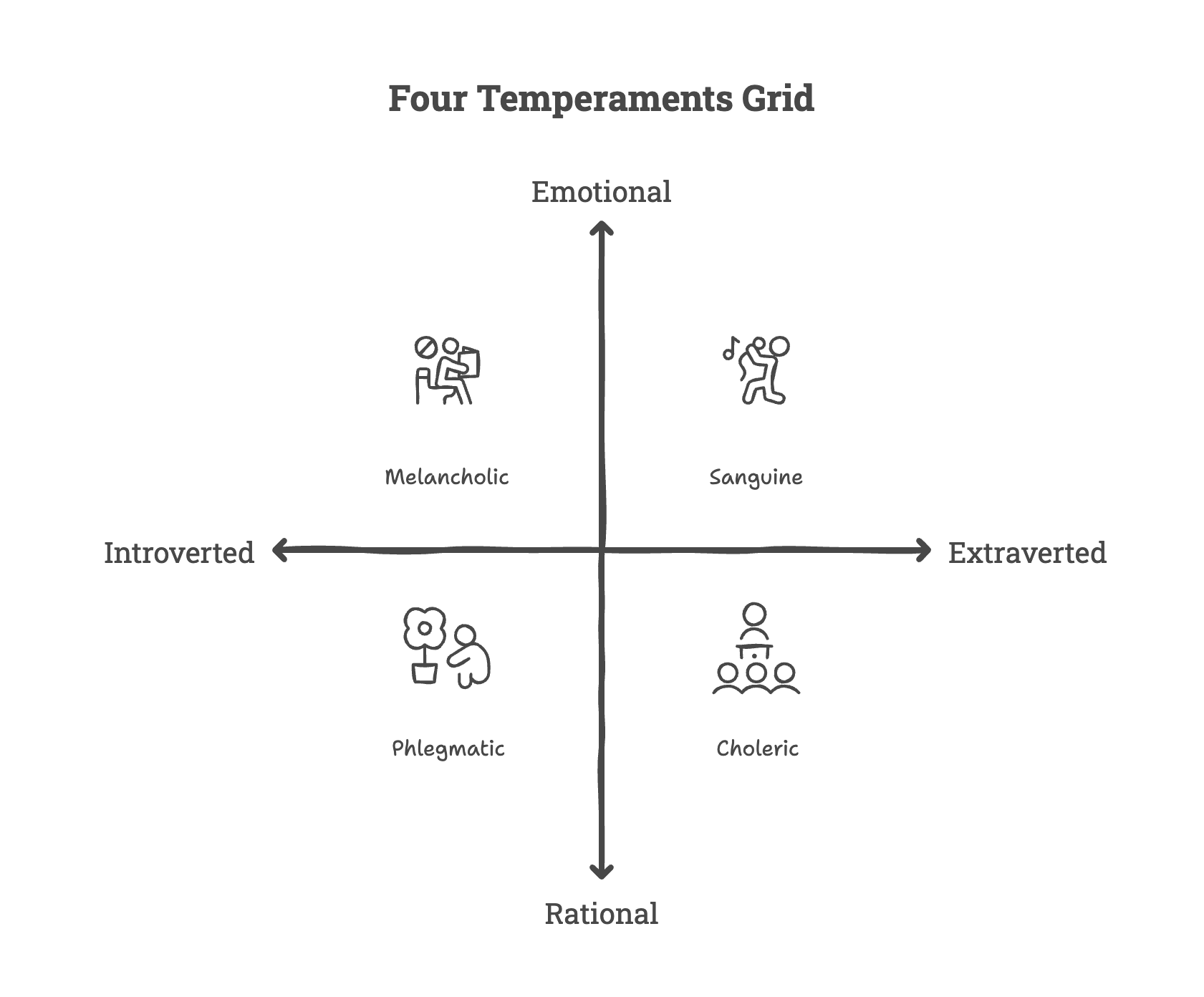
- Extraverted + Emotional → Sanguine: expressive, sociable, spontaneous.
- Extraverted + Rational → Choleric: decisive, assertive, focused on goals.
- Introverted + Emotional → Melancholic: reflective, sensitive, deep thinker.
- Introverted + Rational → Phlegmatic: calm, analytical, prefers stability.
Plot your characters on that grid. You'll instantly see why your cast feels off balance. If everyone's introverted and rational, no one's driving the action. If everyone's loud and emotional, you've got chaos. Mix and match for texture.
📖 The "Voice Triangle" Framework: Personality, Perspective, and Purpose — Once you've mapped temperaments, use this three-part test to make sure each character sounds distinct on the page.
How to Use It While Writing
Here’s the cheat code:
- Assign each character a primary temperament.
- Blend in a secondary one for depth.
- Stress-test them with conflict to reveal who they are.
- Evolve them by forcing growth at the climax.
For example, your Sanguine hero learns focus. Your Choleric leader learns empathy. Your Melancholic detective learns to trust. Your Phlegmatic caretaker finally stands up for themselves. Those arcs hit because they’re wired to temperament.
Why It Works on Your Audience
Every audience member connects most with the temperament they share — or the one they wish they had. A Sanguine audience loves optimism. A Melancholic one loves reflection. You’re not just telling a story; you’re tapping into people’s emotional defaults.
Plus, ensemble stories that use all four types (like The Wizard of Oz, Star Wars, or Fantastic Four) feel balanced and addictive. You’ve got four viewpoints colliding in every scene, which means endless combinations of tension and teamwork.
Famous Examples You Already Know
The Wizard of Oz
- Dorothy (Melancholic): Thoughtful dreamer.
- Scarecrow (Choleric): Planner with purpose.
- Tin Man (Phlegmatic): Heart and patience.
- Lion (Sanguine): Loud courage in progress.
Star Wars
- Luke (Melancholic): Reflective hero turned decisive.
- Han (Sanguine): Chaotic charm.
- Leia (Choleric): Commander energy.
- Obi-Wan (Phlegmatic): Calm mentor.
They don’t just balance the story — they are the story’s rhythm.
Common Mistakes to Avoid
- Don’t make it moral. A Choleric can be kind; a Sanguine can be selfish.
- Don’t make it too pure. Real people blend types.
- Don’t explain it to your audience. Show it through action, tone, and dialogue.
The point isn’t to diagnose your cast — it’s to make them human.
How to Build Temperaments into Your Storyteller OS project
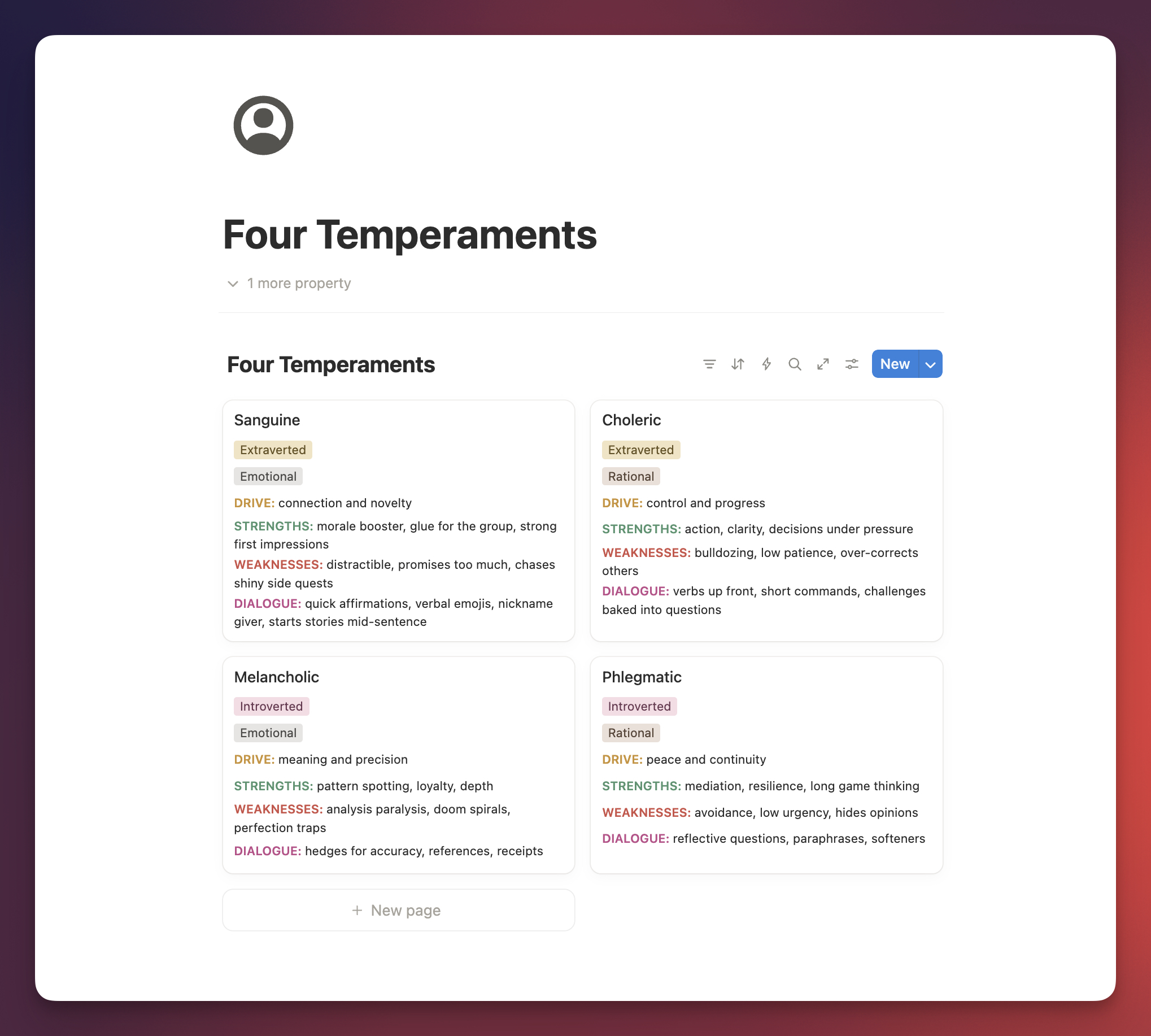
You could track all this on paper, but let’s be real — you’ll probably lose it. Instead, you can add a Four Temperaments database right into your Storyteller OS project to keep everything connected and searchable.
Here’s how to set it up:
- Duplicate this free Four Temperaments database into your Notion workspace and move it into your Storyteller OS project.
- Create a Relation property in that database and link it to your Storyteller OS project’s Character database. This lets you assign a temperament to each character.
- (Optional) Add Rollup properties inside your Character database to pull details — like core drive, strengths, weaknesses, or dialogue tells — from the Temperaments database. That way, you can quickly see how a character might react when you’re writing a scene.➡️ Check out the Storyteller OS here.
It’s a Classic For a Reason
Every writer hits that point where the plot works but the people don’t. This framework pulls your characters out of the mud. It gives you a repeatable system for building believable personalities and stories that actually stick.
That’s the Four Temperaments. Simple. Ancient. Still undefeated.
Contents