Gain the storytelling clarity you seek by having all your notes in one connected system — Meet the Storyteller OS.

The But/Therefore Test: How to Find Where Your Plot's Causality Breaks
Your scenes might be strangers in an elevator, not links in a chain. The But/Therefore Test finds the exact scene where causality breaks — ten minutes, one outline, one pen.

Written by Kevin Barrett
share




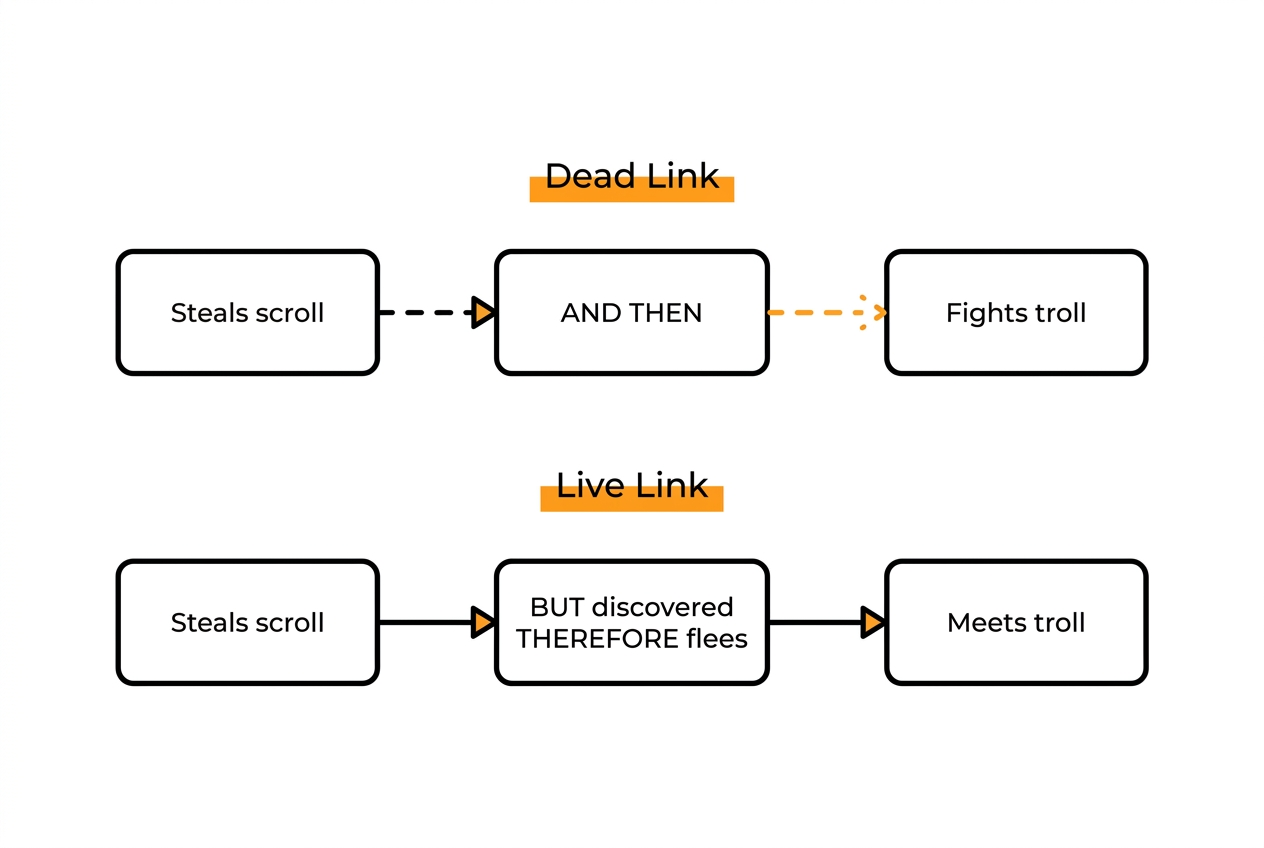
Same troll, one coincidence — one consequence.
🔥 Why this guide exists
No mind was built to hold an entire novel at once. StoryFlint turns the chaos in your head into a story you can see and control — frameworks to order your thinking, and the Storyteller OS to order your project. Bring us the mess.
share
You've read the middle of your draft four times now, and every scene checks out. The dialogue holds up. Pacing's fine.
But somewhere past the midpoint, the story stops pulling and starts listing events. So you did what most writers do: cut the "boring" scene, added a subplot, raised the stakes.
And the middle still sags. It just ags with higher stakes now.
That's because a saggy middle isn't a boring-ideas problem. It's a causality problem, and E.M. Forster diagnosed it in ten words, and it's a distinction James Patterson still teaches in his MasterClass on writing: "The king died and then the queen died" is a story. "The king died and then the queen died of grief" is a plot.
Linking events through cause and effect, not just listing them in order, is what gives a narrative momentum and meaning. More excitement can't repair a missing link.
📖 Cause > Effect > Emotion — The chain this test checks for, plus the third link, emotion, that makes each beat land.
The But/Therefore Test
Its one job: find the exact scene where your plot's chain of cause and effect breaks.
- List the scenes of your middle, one line each. (No outline? List what you've drafted so far.)
- Between each pair of scenes, write the word that honestly connects them: "but," "therefore," or "and then."
- Circle every "and then." Each circle is a dead link, because nothing in the first scene forces the second to happen. Your scenes are just standing next to each other, like strangers in an elevator. Fantasy novelist Jed Herne calls "and then" one of the worst phrases you can say as a storyteller. He's right.
- At each dead link, change one of the two scenes until "but" or "therefore" is the true connector. A scene that can only join its neighbor with "and then" has to change or go.
Watch it work on a two-scene outline: "A thief steals a scroll from the library, and then she fights a troll in the forest." Dead link. The troll is a coincidence.
Now the repair: "She tries to steal the scroll, but she's discovered, therefore she flees the city, therefore she takes the back roads through the woods, therefore she meets the troll." Same troll. Now it's a consequence — one unbroken chain of cause and effect, not a coincidence.
📖 The Domino Effect Framework — A two-question scene test that makes every scene trigger the next, so momentum never breaks.
The pros already run this rule
Trey Parker and Matt Stone plot South Park episodes with it: if two beats on their writers-room board connect with "and then," the episode is broken. Parker's version: "This happened, and then this happened, and then this happens. That's not a movie, that's not a story."
Pixar bakes the same chain into the Story Spine it borrowed from improv teacher Kenn Adams: "But one day... because of that... because of that... until finally."
Breaking Bad's writers refused convenient plot turns; every one had to be forced by what came before. And The Hunger Games hangs an entire trilogy on a single live link: Prim's name is drawn, therefore Katniss volunteers.
Try it on your shelf: take the last story that wouldn't let you go and write the word between its first three beats. It won't be "and then."
Run the test on your second act tonight. Actually tonight, not the "tonight" where you reorganize your character names by hair color instead. Ten minutes with your outline and a pen, and you'll be looking at the exact scene that's been making your middle sag.
The test finds the dead link. Knowing what to put in its place is the harder part, and that's where a circled "and then" can sit for weeks.
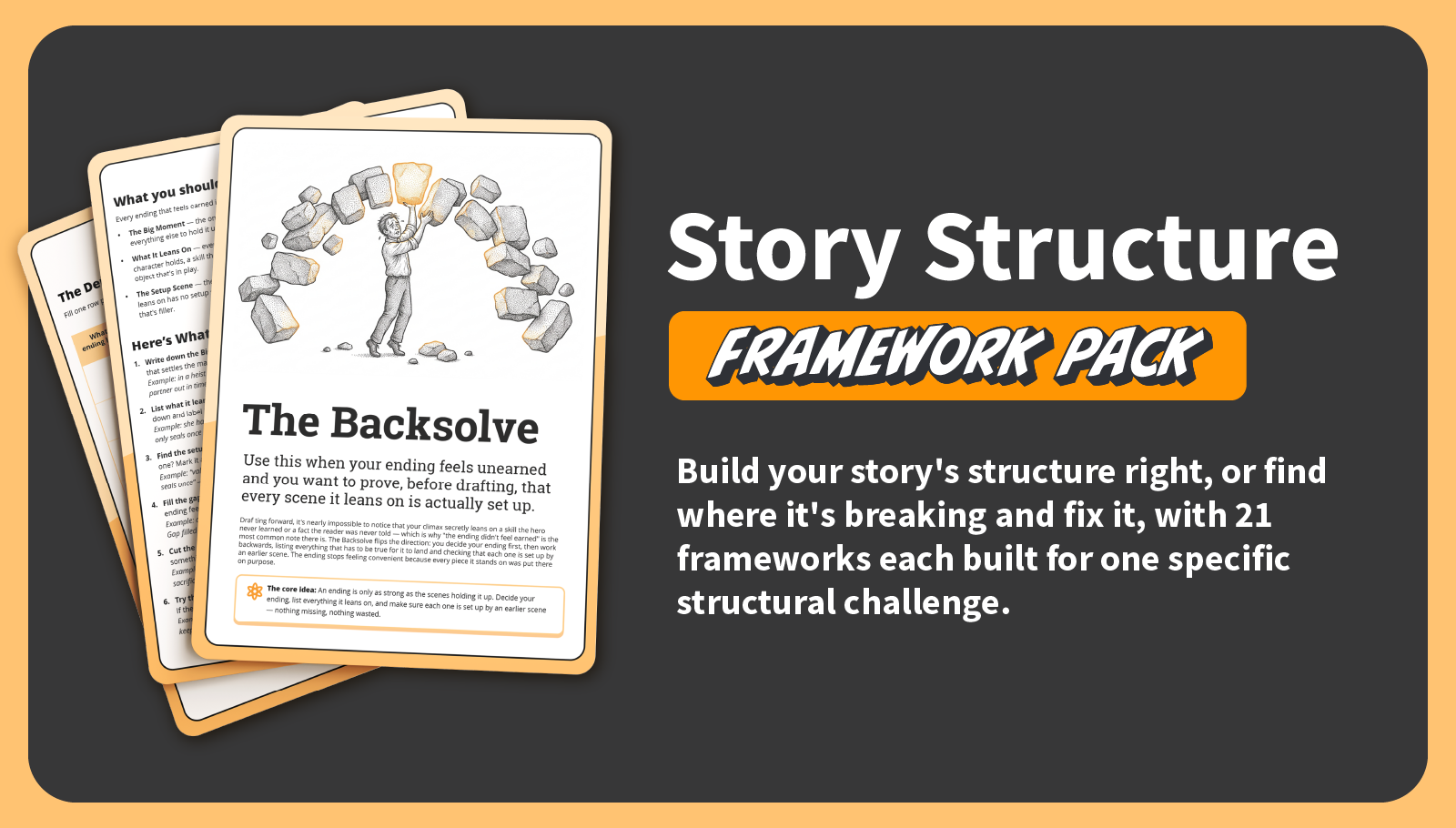
Structure problems don't have one cause, so one framework was never going to be enough. The Story Structure Framework Pack gives you 21 frameworks, each built for one specific structural challenge, whether you're building the chain from the start or hunting the scene where it broke. It comes as a 65-page printable PDF and a Notion database, so you can work on paper or digitally. All of it for $5.
FAQs
Contents