Gain the storytelling clarity you seek by having all your notes in one connected system — Meet the Storyteller OS.

Using the Crucible Framework to Make Stakes Feel Inescapable
Raising the stakes alone won't fix a flat scene. Here's the three-step leak audit that seals every exit and makes it inescapable.

Written by Kevin Barrett
share




🔥 Why this guide exists
No mind was built to hold an entire novel at once. StoryFlint turns the chaos in your head into a story you can see and control — frameworks to order your thinking, and the Storyteller OS to order your project. Bring us the mess.
share
You got the note again: "raise the stakes." So you did: bigger threat, higher cost, more to lose. And the scene still reads flat.
Stakes and pressure aren't the same thing. Stakes are what could be lost. Pressure is what makes losing it feel inescapable.
You can put the world on the line and still write a slack scene, because your character has a dozen exits: they could walk away, wait it out, call for backup. High stakes with an open door just produce a shrug.
Take Die Hard: the stakes (Holly, the hostages) are set in the first ten minutes. The movie doesn't turn unbearable until McClane is sealed inside a locked-down skyscraper with no backup coming. That's the same confined-space pressure John Truby describes in The Anatomy of Story. Same stakes. Suddenly real pressure.
The fix isn't bigger stakes. It's sealing the exits.
📖 5 Ways to Make a Quiet Scene Unbearably Tense: How to build unbearable tension through subtext and withheld information, no extra stakes or action required.
Before you touch the stakes, ask one thing: does your character stay by choice, or because leaving is closed off? If it's choice, you don't have pressure yet — you have stakes.
That's the job of the Crucible — the wall in the pressure framework that answers one question: why can't this character just leave? Physically, socially, or morally, leaving has to cost more than staying. Once that's true, even modest stakes squeeze like a vise.
Building it takes three moves:
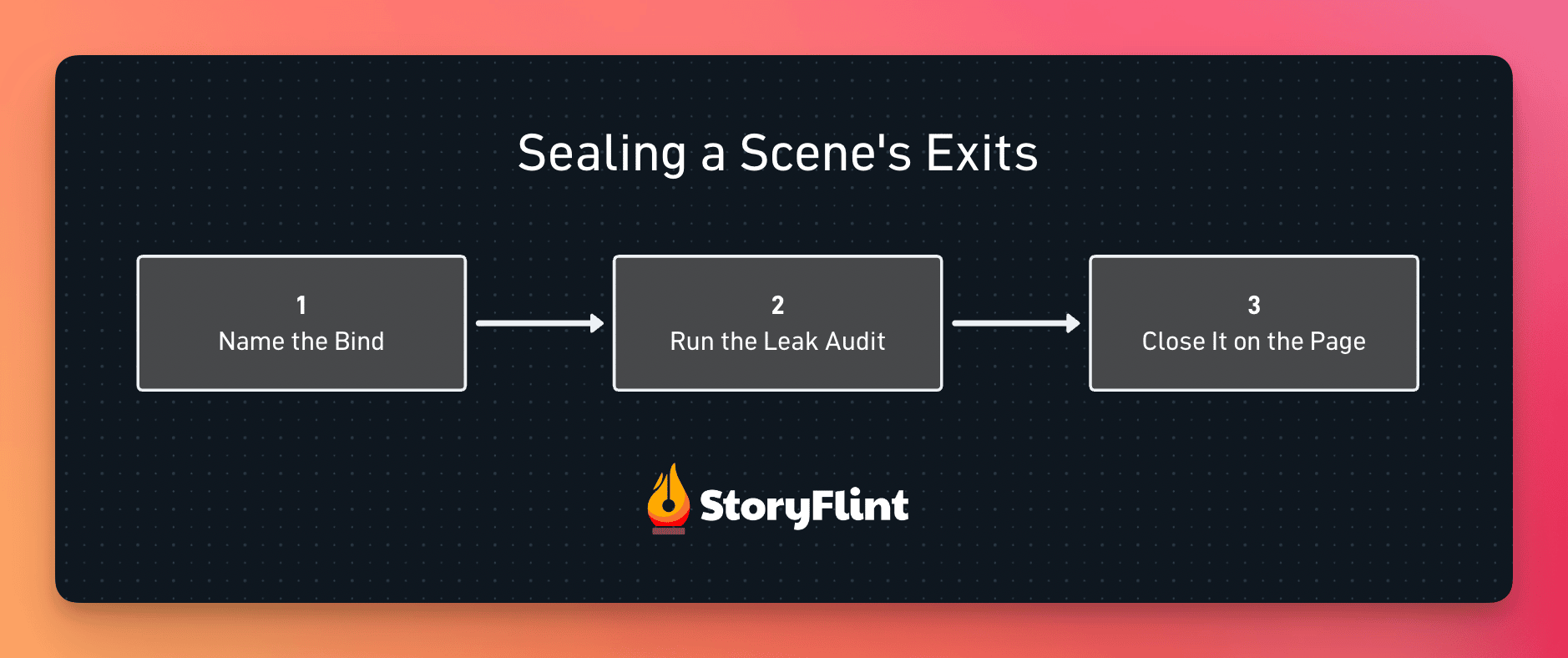
- Name the bind. What actually keeps them in the room?
- Run the leak audit. Ask "what's the exit a reader would imagine?"
- Close it on the page. State exactly what leaving would cost them — not in general, but the specific price for this scene — so the exit reads sealed, not just implied.
Watch it work. Let’s say an accountant just found proof of fraud, sitting across the desk from the man committing it.
Obvious exit: she excuses herself, calls the police from the parking lot.
Leak audit: why doesn't that work? Because the ledgers get shredded tonight. This conversation is her only window inside the office. And if she leaves now, visibly rattled, she tips him off before she has anything to show for it.
Sealed: staying costs her nothing she can point to yet. Leaving costs her the entire case. The door is open. It might as well be locked.
It's the same lock Breaking Bad uses in the garage in the episode "Blood Money": Hank already knows Walter is Heisenberg. The family tie means neither man can walk out of that garage before it gets said out loud.
📖 The Values Collision Model: A five-step framework for forcing characters into gut-punch moral dilemmas that raise the stakes through impossible choices.
Try it tonight. Pull up your weakest scene and ask:
- Why can't my character walk away right now — physically, socially, or morally?
- What's the exit a reader would think of first?
- Have I closed that exit on the page, or just hoped nobody would ask?
If you can't answer the third one, that's your leak. Your editor's next note won't be "raise the stakes" again. It'll be "why can't he just leave?" (a worse-sounding note that happens to be the better one).
This is one wall out of three: the Crucible pairs with the Contract (the promise you owe the reader) and the Clock (the deadline that keeps shrinking) to build full pressure.
The Crucible fixes one leak. But if your sagging middle isn't a Crucible problem, if it's a Contract you forgot you made, or a Clock that stopped ticking, sealing exits won't save that scene.
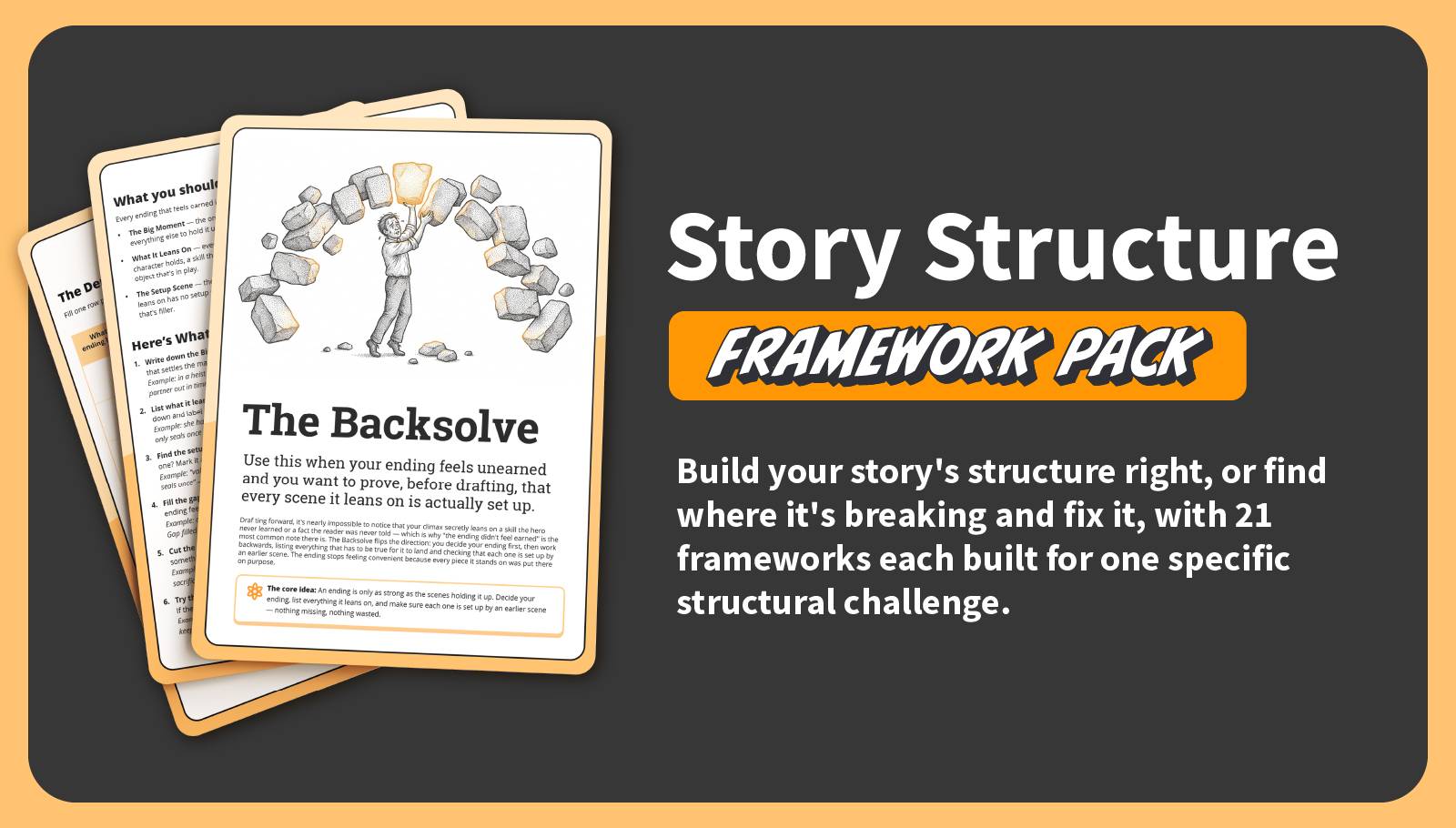
Structure problems don't have one cause, so one framework was never going to be enough. The Story Structure Framework Pack gives you 21 frameworks (this wall, plus 18 more for the structural problems this one doesn't touch), whether you're building your structure right from the start or finding exactly where it's leaking. A 67-page printable PDF and a Notion database, so you can work on paper or digitally. All for $5.
FAQs
Contents