Gain the storytelling clarity you seek by having all your notes in one connected system — Meet the Storyteller OS.

The One Rule That Makes a World Feel Real
Don't invent everything. Invent one thing, let it ripple, and watch your world finally feel real.

Written by Kevin Barrett
share




🔥 Why this guide exists
No mind was built to hold an entire novel at once. StoryFlint turns the chaos in your head into a story you can see and control — frameworks to order your thinking, and the Storyteller OS to order your project. Bring us the mess.
share
I've watched too many writers stumble into the same worldbuilding trap. You take the advice to build everything: the economy, the magic system, the politics, the moon cycles. Months later, you have a gorgeous fantasy calendar and zero chapters. Yeah.
There's a quieter rule the best speculative writers actually follow. You only get to change one thing. And the smaller that one thing feels to the people living inside it, the more real your world becomes.
The "What If" That Holds a World Together
N. K. Jemisin calls this Element X. It's the single foundational oddity at the heart of every speculative story.
She frames it as a "What if" question. What if magic existed? What if this story is set in the future? What if there's a metal that absorbs vibration? That premise defines what is possible in the story and binds the entire narrative together.
Ideally Element X is one seemingly insignificant thing as far as the people in your world are concerned.
They've normalized it. They don't gawk at it. Which means you don't have to spend a third of your manuscript explaining it.
📖 How to Create a Fantasy World That Your Audience Will Love — A practical companion for designing the wider world your Element X has to live inside.
Drop a Stone, Then Follow the Ripples
Author Adrian Tchaikovsky uses a different image for the same idea. You're dropping a stone into a pool, and each ripple is a consecutive logical therefore.
If that's true, then this must be true. If this must be true, then that must be true. Eventually you've built an entire world. Not from twelve disconnected cool ideas. From one seed.
That's why a focused Element X is more powerful than a sprawling one. You're not inventing in twelve directions at once. You're inventing in one direction, then doing physics.
📖 How to Create a World Building Bible: The Ultimate Guide — Once you've chosen your one rock, here's how to track every ripple it creates without losing the thread.
The One Big Lie Rule
Tchaikovsky has a related rule. You get one big lie: the convenient impossibility your plot needs to exist. To support that lie, everything else needs to be true.
In his novel Children of Time, the big lie isn't the spiders. The lie is the amount of time their uplift takes. The actual evolutionary and behavioral details are scientifically grounded, which is what makes the speculative leap land.
Pick your impossibility. Then make every surrounding detail honest.
Why "Insignificant" Is the Secret Word
An Element X that only changes one character or one plot point stays surface-level. Weave it into the economy, culture, religion, and identity of a world, and you've built something that can't be replicated.
📖 Developing Your Story Setting – 9 Tips to Help — Nine concrete moves for pushing a setting past surface detail into economy, culture, and identity.
Vibranium isn't just a cool metal. It drastically impacted and shaped Wakanda's economy and culture.
It shows up in politics, religion, identity, and technology. Pull it out and you don't have Wakanda anymore.
But Vibranium is one element. Not twelve. And Wakandans treat it as normal. Big change, small feel.
Three Worlds, One Element Each
The Hunger Games. What if a government broadcast child murder as entertainment? The Capitol's fashion, the districts, the Reaping, Katniss's whole arc all ripple out from that one premise.
Black Panther. Vibranium is the one rock. Everything downstream moves because that rock exists: Wakanda's economy, culture, isolationist politics, identity.
Children of Time. Here the "what if" is sneakier. What if a nanovirus accelerated the uplift of a colony of spiders fast enough to span a single human lifetime? The spider biology, how they think, build, and communicate, is scientifically careful. Only the timeframe is borrowed from fiction. That's the lie. Tchaikovsky earns it because everything around it is true.
Build Inward, Not Outward
Pick one thing. Make it small enough that your characters wouldn't comment on it. Then trace the ripples until the world is dense enough to walk through.
The temptation is to add more. More systems, more lore, more weird.
But every extra Element X you invent costs you coherence. One lie, rigorously supported, will always feel more real than five lies stacked sideways.
The world doesn't need to be bigger. It needs to be more honest about its one impossible thing.
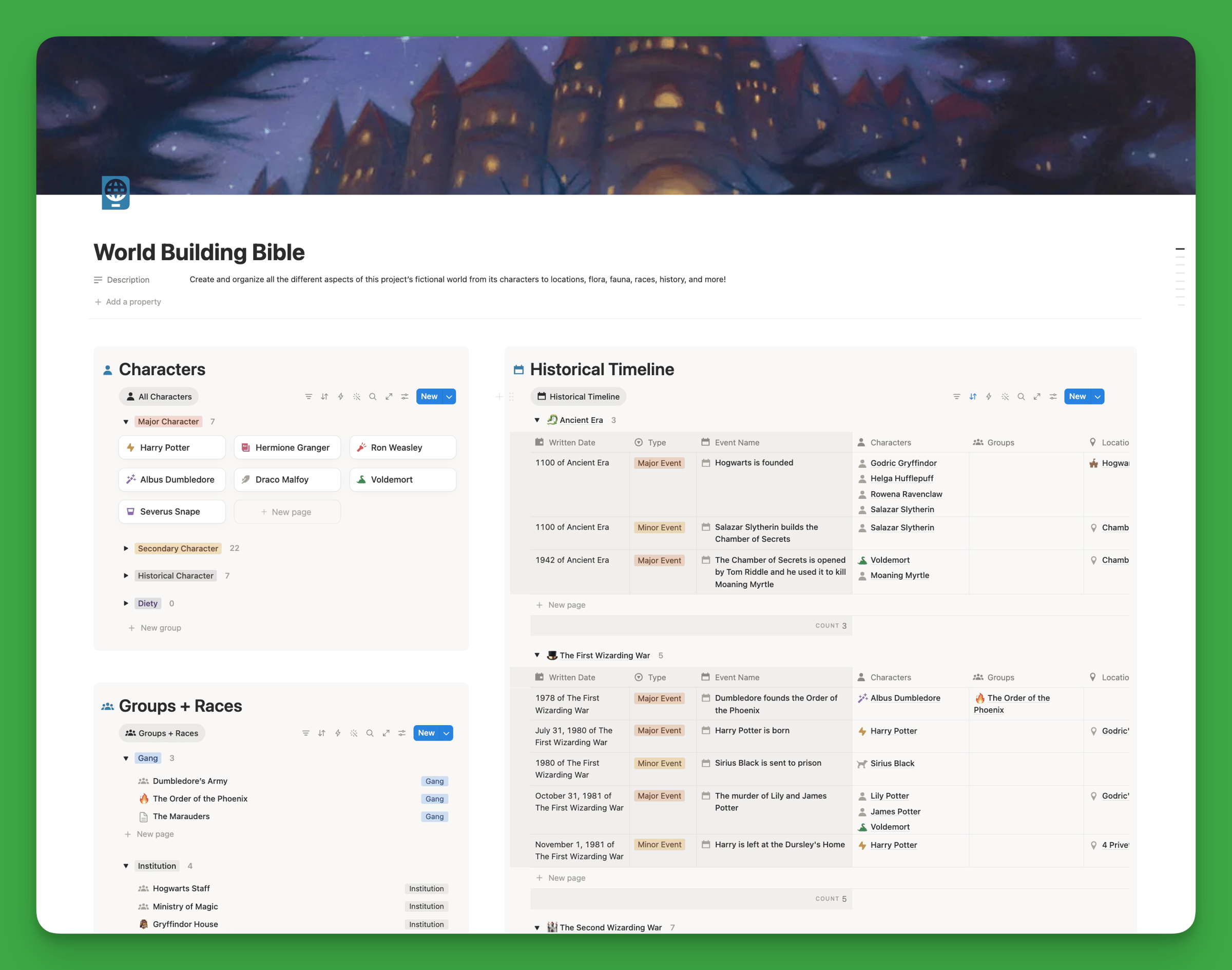
That single Element X only stays coherent if you can actually find every ripple it created when you sit down to write. The economy it shaped, the religion it altered, the character bound up in it — none of that pays off if it’s scattered across half a dozen apps and old drafts.
World-building is only useful if you can find it when you need it. The Storyteller OS gives your fictional world a home — every location, faction, rule, and ripple from your one impossible thing organized and connected so nothing gets lost between drafts.
See what’s inside the Storyteller OS.
For a closer look at how it’s built: How I Used Notion to Build the Ultimate Storytelling System.
Contents