Gain the storytelling clarity you seek by having all your notes in one connected system — Meet the Storyteller OS.

How Storyteller OS Helped a Retired Software Developer Organize His Fantasy Series
He didn't need more inspiration. He needed a way to stop losing track of what he'd already created.

Written by Kevin Barrett
share




How Storyteller OS helped a retired software developer organize a sprawling fantasy series and stop losing ideas.
🔥 Why this guide exists
No mind was built to hold an entire novel at once. StoryFlint turns the chaos in your head into a story you can see and control — frameworks to order your thinking, and the Storyteller OS to order your project. Bring us the mess.
share
The Folder Everyone Has
You have a folder called "story stuff" somewhere on your desktop. Forty character sketches that don't sound like they were written by the same person. Three timelines that quietly disagree with each other. A spreadsheet you stopped updating in March. A document named "NOTES (real, this time)." You know it's all in there. You just don't know where.
A Retirement Project With No Instructions
Danny Lowell knew that feeling from the inside. He'd spent a career in software development — work that rewards you for building systems that hold together under pressure. After retiring, he finally turned to a lifelong dream: writing novels. He set out to design a fantasy series, the sprawling kind, with its own history, its own geography, and a cast of characters who all needed to remember things about each other.
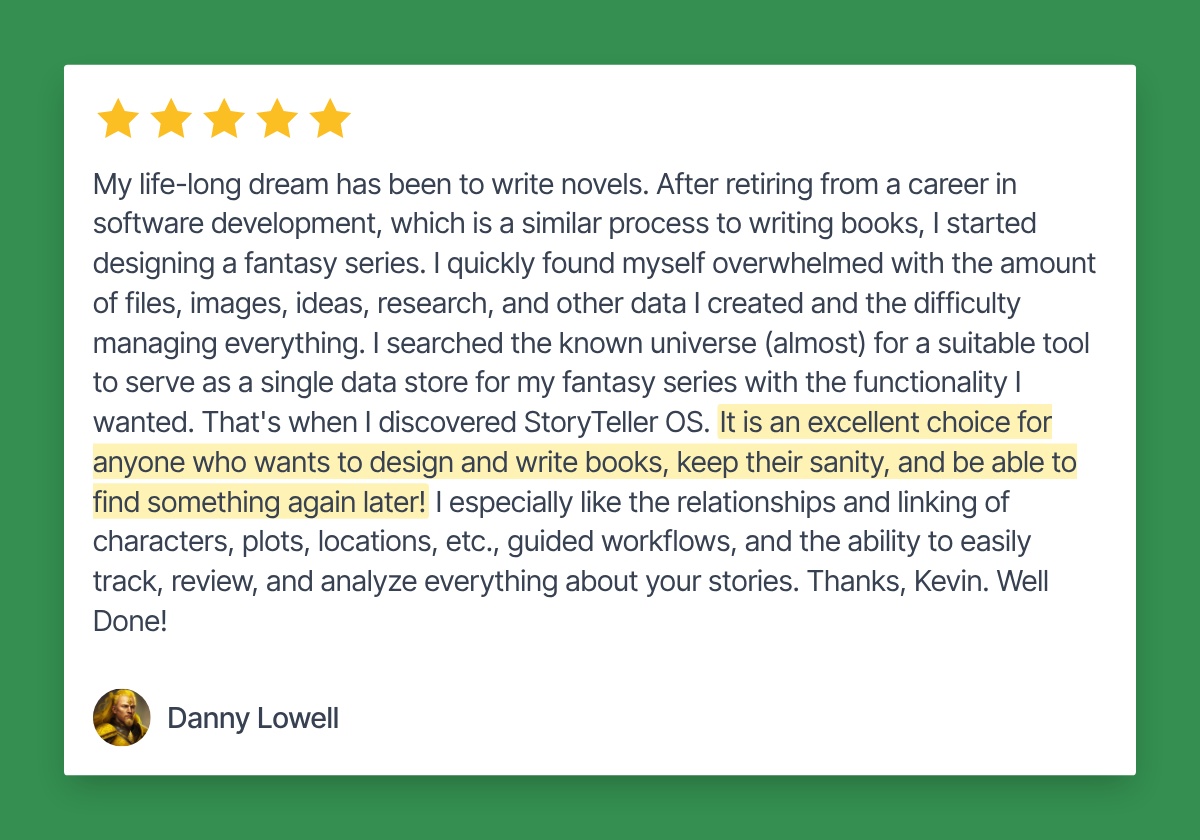
The writing itself wasn't the hard part. The hard part was everything writing generates. Within weeks, Danny had built more material than any single tool he owned could hold. As he put it: "I quickly found myself overwhelmed with the amount of files, images, ideas, research, and other data I created and the difficulty managing everything."
The Search for Somewhere to Put It All
So he went looking. Not for inspiration — he had plenty of that. He went looking for a place to put things. "I searched the known universe (almost) for a suitable tool to serve as a single data store" for his fantasy series, with the functionality he wanted. "That's when I discovered StoryTeller OS."
One Connected System, Not a Muse
There's no lightning-strike moment here, and that's the point. Storyteller OS isn't a muse. It's a Notion system — a structured place for characters, plots, and locations to live in relation to each other instead of scattered across folders and tabs. Danny didn't need permission to be creative. He needed a system that wouldn't lose what he'd already made.
"It is an excellent choice for anyone who wants to design and write books, keep their sanity, and be able to find something again later!" Danny said. What sold him wasn't a feature list — it was the connections. "I especially like the relationships and linking of characters, plots, locations, etc., guided workflows, and the ability to easily track, review, and analyze everything about your stories."
That's the shift, in plain terms: a fantasy series that used to live in scattered files and half-remembered spreadsheets now lives in one connected system Danny can actually navigate — and trust.
The Lesson That Isn't About Notion
Here's the part that holds even if you never build a fantasy world, never open Notion, never buy a single template: the problem was never a lack of ideas. Danny had those in abundance — that's how he ended up overwhelmed in the first place. The problem was that ideas without a system to hold them just become more things to lose. Every half-finished "story stuff" folder is one relational database away from becoming useful. The creativity was always there. It just needed somewhere to live.
If This Sounds Familiar
If that sounds familiar, here's the offer, plainly: most writers don't have a writing problem. They have an organization problem. The Storyteller OS is the Notion system built to fix that — one place for every character, plot thread, world detail, and scene, so you can stop hunting through scattered notes and start actually writing. You can build something like it yourself, or you can start from the one that already exists.
Contents