Gain the storytelling clarity you seek by having all your notes in one connected system — Meet the Storyteller OS.

Flexibility, Not Features: What a Novel Organization System Actually Needs
A novel organization system has to bend with your story, not box it in. Here's what breaks folder-based systems at scale.

Written by Kevin Barrett
share




🔥 Why this guide exists
No mind was built to hold an entire novel at once. StoryFlint turns the chaos in your head into a story you can see and control — frameworks to order your thinking, and the Storyteller OS to order your project. Bring us the mess.
share
Nobody starts out disorganized. You start with a folder. Then a folder inside the folder. Then a document that lists what's in the other documents. It works, right up until the day you open all three, still can't find when a character's mother died, and start searching for a novel organization system that can actually hold what you've built instead of just storing it.
That search means one thing: your story got big enough to matter. The system didn't fail on day one. It's failing now, at the exact point it was always going to be tested.
Years of Google, and Then a Wall
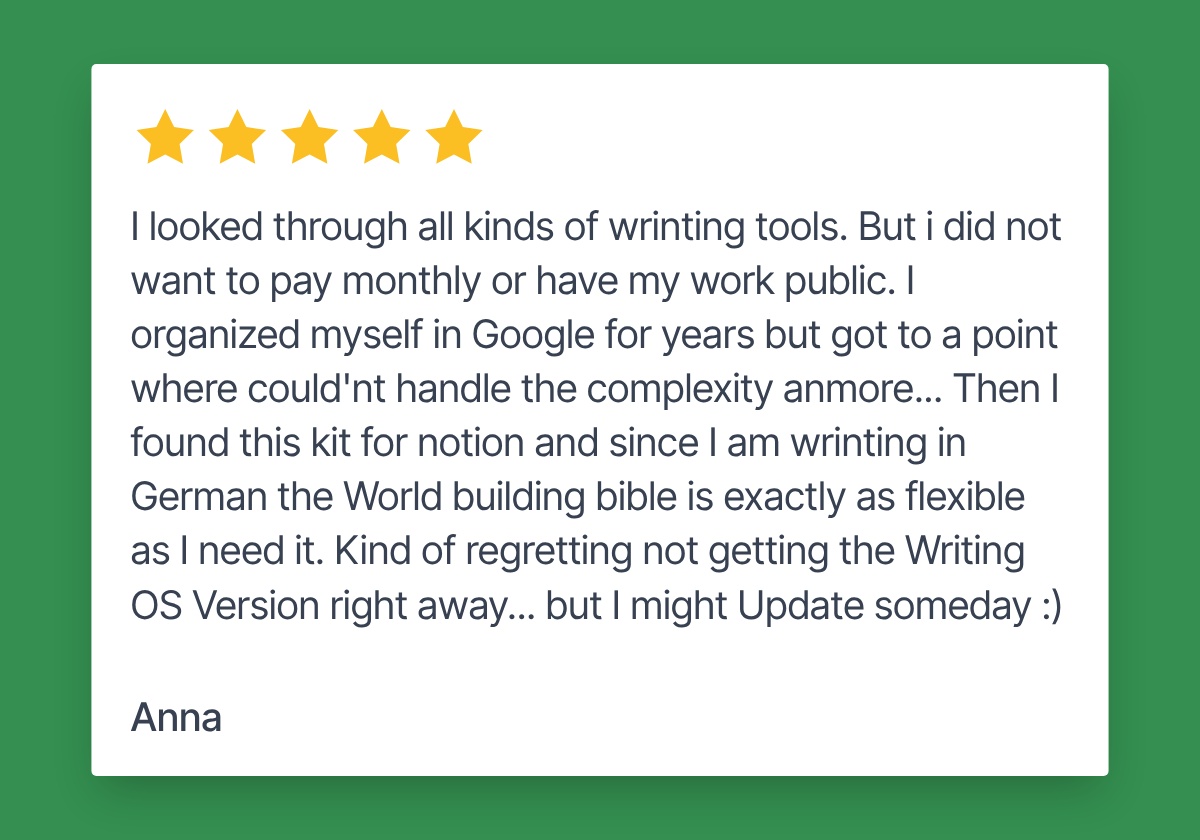
Anna had two conditions before she'd touch any writing tool: no subscription, and nothing public. Most world-building software asks you to break one or the other, so she skipped all of it and built her own system in Google. She ran it for years.
I organized myself in Google for years but got to a point where I couldn't handle the complexity anymore.
Notice what that sentence isn't. It isn't "I gave up." It's "I hit a ceiling." Anna didn't fail at organizing her story. She succeeded long enough for the story to get complicated enough to need something a stack of docs was never built to give her.
Here's the actual mechanism. A flat pile of documents scales in a straight line: one doc, one character, ten docs, ten characters. Stories don't grow in a straight line. They grow in a web, the same way Notion's relation properties are built to track. One character connects to three locations, four events, and a timeline that has to agree with itself every time something changes. A folder can hold a fact. It can't hold the fact that changing one thing means five other things need to know about it. That gap, not the document count, is what breaks first.
The Part That Mattered Wasn't the Features
When Anna moved to StoryFlint's World Building Bible, the thing that solved her problem wasn't a bigger toolkit. It was that the toolkit bent to fit her.
Since I am writing in German, the World Building Bible is exactly as flexible as I need it.
That's a small sentence carrying a big point. Most writing software gets built in English, for English, by people thinking in English categories. A rigid structure doesn't announce that bias out loud. It just quietly assumes you'll write the way it expects. A system you can rename, restructure, and reshape doesn't carry that assumption. It doesn't care what language lives in your head. Anna got that flexibility without giving up either of the two conditions she started with.
That's the part worth noticing if you're evaluating any novel organization system: the value isn't how many databases it ships with. It's whether you can bend it into the shape your specific story needs, in whatever language or logic you're actually thinking in.
What This Actually Tells You
Most writers judge an organization system by how it feels on day one, with almost nothing in it yet. That's the wrong test. Everything feels fine with three characters and one timeline. The honest test is year three: eighty characters, two hundred years of fictional history, a plot that's rewritten itself twice.
Run the year-three question against whatever you're using right now, spreadsheet, index cards, or the tool you just downloaded:
- Can you find one fact in under thirty seconds?
- When you change something in one place, do the related places know?
- Can you reshape the whole thing, or would you have to start over?
If any answer comes back no, your system isn't broken yet. It's scheduled to break. That thirty-second test is exactly what a personal knowledge base built in Notion is designed to pass, fact retrieval first, everything else second.
Anna's already looking past the version she bought:
Kind of regretting not getting the Writing OS version right away... but I might update someday :)
That's what it sounds like when someone senses, after the fact, how much room they'd been missing the whole time. (Writing OS is StoryFlint's flagship, now called the Storyteller OS.)
If You're at the Wall
You can build this yourself. Anna did, for years, in Google, before she needed something else. Notion gives you the raw pieces to do it if you'd rather build than buy. Or you can start from a system built to handle the hard part already.
World-building is only useful if you can find it when you need it. The Storyteller OS gives your fictional world a home, every location, faction, rule, and detail organized and connected so nothing gets lost between drafts. The World Building Bible sits inside it as one piece, next to the character work, the plot outline, and the theme builder. No subscription. Nothing public.
See how the Storyteller OS keeps everything connected.
Read how I built the Storyteller OS.
Your system will hit its limit eventually. The only question is whether you meet it with something built to bend, or a folder full of documents you can't search.
FAQs
Contents