Gain the storytelling clarity you seek by having all your notes in one connected system — Meet the Storyteller OS.

How to Audit a Character Arc as a List of Choices
Run a character arc audit in one sitting: list every choice your page-one character would refuse, price each one, and find where the arc actually breaks.

Written by Kevin Barrett
share




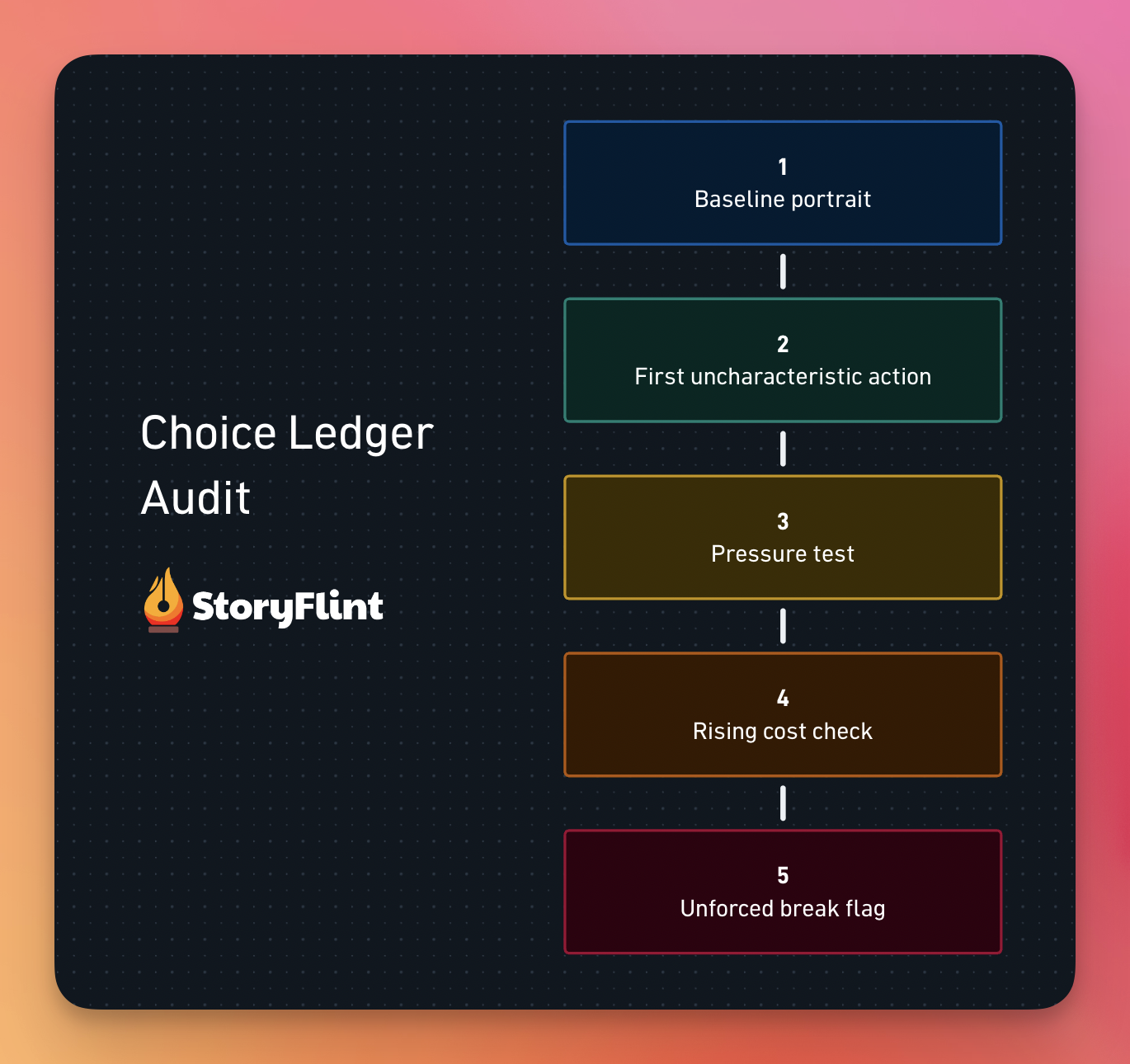
The five steps of the Choice Ledger, from baseline portrait to the unforced break flag.
🔥 Why this guide exists
No mind was built to hold an entire novel at once. StoryFlint turns the chaos in your head into a story you can see and control — frameworks to order your thinking, and the Storyteller OS to order your project. Bring us the mess.
share
A reader tells you the arc "didn't land."
So you go looking for the page where your character changed. You find the page where they realized it. Doubt, a hard conversation, the scene where they finally say the thing out loud.
All of it is on the page. None of it is a moment you can point to.
So you do the pass you always do. You add more inner monologue. Fourth time this month.
Your reader was never grading the thinking
Here's the uncomfortable part. Your reader wasn't tracking your character's thoughts. They were tracking their behavior.
A monologue is your character testifying about their own growth, and nobody convicts on testimony alone. Every scene of realization you added is more testimony. A character arc only becomes authentic when it's externalized through choices made under pressure.
Test it on your own draft. Delete every line of thinking from the scene where you think your character changed. Would a reader still know something shifted? If not, that isn't the scene where it happened.
Which hands you something better than a feeling. If change only counts when your character acts, an arc is a list of actions. And a list can be audited.
📖 The One Thing Your Hero Would Never Do — How to find the single action that breaks a character's pattern and starts the arc.
The Choice Ledger
One job: turn an invisible arc into a list you can audit.
Here's a finished one. Walter White from Breaking Bad:
- Baseline: a high school chemistry teacher who insists the cooking is for his family.
- Entry 1: he kills Krazy-8 in Jesse's basement instead of letting him go. Cost: the last version of himself that isn't a criminal.
- Entry 2: he turns down Gretchen and Elliott's money, the money that would have paid for the treatment. Cost: his own excuse.
Two entries, and the "I did it for my family" story is already dead on the page. Years before Walt admits it out loud.
Now build yours. Five steps, one sitting.
- Set the baseline. Write who your character is in the opening scenes, specifically and unflatteringly. Ambitious, petty, self-righteous, whatever it actually is. Every entry gets measured against this.
- Find entry #1. Not the realization. The first action your baseline character would not have taken.
- Qualify every entry. Only choices made under pressure count, where something was at stake and something got lost. An internal change still has to cash out as a decision somebody can watch, or the reader just has your word for it.
- Price each entry. Write what the choice cost your character right next to it, in one phrase.
- Read the costs in order. Each one should be higher than the last. If entry three is cheaper than entry one, you have two half arcs wearing a single character's name.
Two more ledgers, same shape
Michael Corleone from The Godfather:
- Baseline: the war hero who tells Kay that's my family, not me.
- Entry 1: he volunteers to shoot Sollozzo and McCluskey in the restaurant. Cost: the civilian life he promised her.
- Entry 2: he stands as godfather at the baptism while his men kill the heads of the other families. Cost: any line left between him and his father.
Katniss Everdeen from The Hunger Games:
- Baseline: a girl who keeps her family alive by staying invisible and breaking only the rules nobody enforces.
- Entry 1: she volunteers as tribute in Prim's place. Cost: the invisibility that kept her alive, in front of the whole district.
- Entry 2: she pulls out the nightlock and forces the Capitol to allow two victors. Cost: any chance of going home unnoticed, and a Capitol that now needs her dead.
Same rule running underneath all three. Every entry costs more than the one before it, and nobody in them announces the change first.
Put your own entries next to these. If yours don't get more expensive as they go, you don't have a broken character. You have an unfinished list.
Do it tonight
Run the ledger on your first act tonight. Actually tonight, not the "tonight" where you reorganize your character templates and call it progress.
By the end of it, "something's off" becomes "nobody chooses anything between entry two and entry three." That version you can fix.
The ledger usually ends up spread across an outline, a notes app, three chapter drafts, and your memory, which is the same reason you couldn't point to the moment tonight. The Storyteller OS gives every character their own space, with their ledger, their arc, and their relationships sitting in one place.

See how the Storyteller OS handles characters.
If five steps is more than tonight has room for, do two. Baseline and entry #1. Most arcs that "didn't land" break right there, and you'll know inside ten minutes.
FAQs
Contents