Gain the storytelling clarity you seek by having all your notes in one connected system — Meet the Storyteller OS.

The Pressure Test: A One-Scene Method for Finding Who Your Character Is
Reveal character through choices, not questionnaires. The Pressure Test: one throwaway scene, two bad options, and the contradiction it exposes.

Written by Kevin Barrett
share




🔥 Why this guide exists
No mind was built to hold an entire novel at once. StoryFlint turns the chaos in your head into a story you can see and control — frameworks to order your thinking, and the Storyteller OS to order your project. Bring us the mess.
share
You know your character's birthday. You know their childhood dog, their coffee order, the street they grew up on.
You answered all hundred questions. And they still walk onto the page like a résumé with legs. Question 47 was their favorite season. It did not help.
So you go back and answer more questions, because the missing piece has to be in there somewhere. It isn't. That questionnaire isn't broken. It's just answering a different question than the one you're asking.
The Chart That Can't Explain a Decision
A profile is a medical chart. It tells you height, weight, history, everything true about a patient sitting perfectly still. True character shows up somewhere else entirely: in the choices a person makes under pressure. The greater the pressure, the deeper the revelation, the truer the choice to who that person actually is.
Here's the part questionnaires skip. A list of admirable traits tells a reader what your character is supposed to be. It never tests whether that trait survives contact with a real cost. "Brave" on a profile is a claim. "Brave" in a scene where bravery costs something is evidence.
If character only shows up under pressure, then character is something you can test. That's the whole idea behind the tool below.
The Pressure Test
The Pressure Test has one job: show who your character actually is, in a scene you'll never publish.
Three fields. That's the whole output:
- Situation. Hand your character two bad options. Not a right answer and a wrong one, but two costs with no way to pay only one of them. Bonus if nobody's watching: a choice made alone can't be a performance.
- Choice. Make them pick, and make them pay. Write the choice and the price in a single line. If nothing gets lost, you built the options wrong. And if you don't know which one they'd take, good. That's what you're testing for.
- Contradiction. One sentence: what does this choice say that their surface doesn't? Characters feel most alive when they contradict themselves.
One objection before the example: this only works if the two options are genuinely bad. A choice between "save the town" and "eat a sandwich" reveals nothing, because nobody has to pay for picking the sandwich. Both options need a real cost, or the test just measures which option you secretly wanted them to choose.
Batman's Two Addresses
Run the test on Batman in The Dark Knight, and you get this:
- Situation: The Joker hands him two addresses and not enough time. Rachel or Harvey.
- Choice: He drives for Rachel. The Joker swapped the addresses, but the choice was already made.
- Contradiction: The man whose entire identity is "Gotham first" goes for his love, not the man he believes can actually save Gotham. That's what he won't sacrifice.
Notice what the test caught that a questionnaire never would. Batman's profile says "puts the city first, every time." His choice says otherwise, and the gap between those two things is more interesting than either one alone. That gap is the character arc waiting to happen — the story can now spend two more films finding out which version of Batman wins.
📖 The Lie Your Character Believes — Where the gap between a character's surface and their truth comes from in the first place.
Three More Characters, Same Three Fields
Katniss, The Hunger Games. Prim's name comes out of the bowl, and Katniss volunteers before anyone can stop her. The girl who survives by never giving the Capitol a reason to look at her raises her hand in front of the entire district.
Michael Corleone, The Godfather. Sollozzo and McCluskey need to die, and Michael offers to do it himself. The war hero who told Kay "that's my family, not me" sits down in a restaurant and makes it his.
Rick, Casablanca. He puts Ilsa on the plane with Laszlo, and the man who sticks his neck out for nobody pays for it with the only thing he wanted.
None of them explained themselves. Each one made a choice that cost something, and the cost did the characterizing. Run this across a full cast and you'll notice something else: the trait each choice contradicts is usually the exact trait tied to your story's central theme — which is a good sign you're testing the right characters.
📖 Writing Indirect Characterization — How to reveal who someone is through action and choice instead of stating it outright.
Pick the character you're least sure about and write their three fields right now. If the Contradiction line comes out empty, you haven't found their choice yet. You've found their description.
Characters are the heart of every story — but keeping track of who they are, what they want, how they change, and how they relate to everyone else is its own full-time job. The Storyteller OS gives every character their own space, with all the details, arcs, and relationships connected in one place. See how Storyteller OS handles character work.
For the full build story: How I Used Notion to Build the Ultimate Storytelling System.
Run This Tonight
Run the Pressure Test on your protagonist tonight. Actually tonight, not the tonight where you reorganize your worldbuilding folders and call it progress.
One page, two bad options, one contradiction you didn't see coming. You'll know it worked when the choice surprises you.
Run the Pressure Test on your protagonist tonight.
One page, two bad options, one contradiction you didn't see coming. You'll know it worked when the choice surprises you.
You won't run this test once. Ten characters in, you'll have ten contradictions worth keeping and no idea which document you left them in.
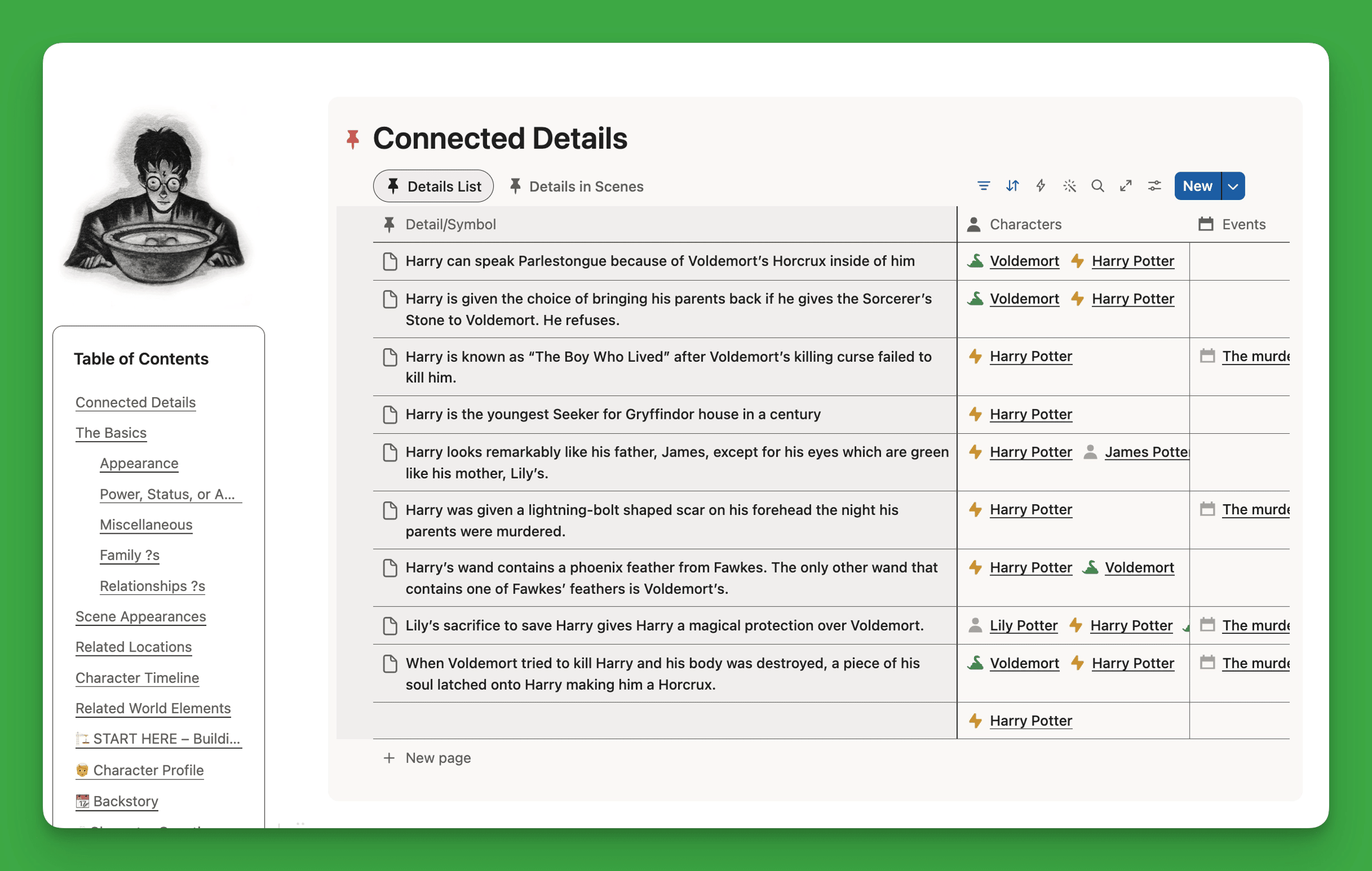
That's the job the Storyteller OS does. Every character gets their own space, with their fields, their arc, and everyone they're tangled up with in one place, instead of a hundred answered questions that never added up to a person. See what's inside the Storyteller OS.

Want the build story first? How I Used Notion to Build the Ultimate Storytelling System.
FAQs
Contents