Gain the storytelling clarity you seek by having all your notes in one connected system — Meet the Storyteller OS.

The Secret to a Great Reveal Scene: Character Stakes
Same shot, same music—one made people cry. Three stakes separate a reveal from a fancy zoom-in.

Written by Kevin Barrett
share




🔥 Why this guide exists
No mind was built to hold an entire novel at once. StoryFlint turns the chaos in your head into a story you can see and control — frameworks to order your thinking, and the Storyteller OS to order your project. Bring us the mess.
share
The reveal isn't the event. It's the payment.
A reveal lands when it completes something a character has been carrying for the whole story. The reveal isn't the moment. It's the receipt for everything that came before.
Cut the reveal scene out of your story entirely. Can the audience still tell you what this character wanted, feared, or believed about themselves?
If yes, the stake is planted. If no, the seeding isn't there yet, and the reveal will land flat no matter how cinematic it looks.
📖 What Is Chekhov's Gun? — Why every payoff needs a planted seed earlier in the story, and how to do it without telegraphing.
Three stakes that make a reveal hit
Most failed reveals are reveals that don't know which type they are.
Desire
I think the strongest reveals start here: the character has wanted something forever, and the reveal hands it over.
Alan and Ellie are paleontologists who grew up loving dinosaurs so much that they went into the field of dinosaur study and dreamed to see them as kids. When the brachiosaur rises into view, that isn't spectacle.
That's a childhood dream getting paid off in real time. The audience feels the catharsis with them because we know what they appreciate.
Fear
The character has been afraid of something, and the reveal confirms it.
Hereditary spends 90 minutes building dread (possession, inheritance, loss of control) and then puts Annie in the attic rafters. Every fear the audience has been carrying cashes in at once.
Identity
The character thinks they know who they are. The reveal recontextualizes that and forces a choice.
"No, I am your father." Luke's entire identity has been built on avenging his father, and now he is the son of the man he was hunting.
The reveal doesn't just shock. It collapses an identity and demands a new one.
📖 The Lie Your Character Believes — How false identity beliefs become the engine of a character arc, and the target of every great identity reveal.
The famous reveals that whiffed
Three reveals that should've been iconic. None landed.
Bran the Broken. He never wanted the throne. Eight seasons of characters who craved power, feared losing themselves to it, or had a bloodline claim to it.
Then the show handed the crown to the one guy without any of those stakes. The reveal had no stake to complete.
"Somehow, Palpatine returned." Two films of total absence cannot be retroactively reframed in the first thirty seconds of a third. The seeding window has to be at least as long as the payoff is heavy.
The Indominus Rex. Jurassic World engineered a bigger, scarier animal and built a full reveal around it. What it couldn't engineer was a person inside the frame who had waited a lifetime to see it. The magic in 1993 was the human reaction, not the dinosaur, and stakes don't transfer between films.
📖 How to Write Stakes in a Story — The deeper mechanics of stakes (personal, plot, external) and how to layer them for max emotional weight.
Decide the type before you write the scene
Pick which stake you're paying off (desire, fear, or identity) and seed it from the first act.
A desire reveal needs a lifelong want planted early. Fear reveals work when the audience has been carrying dread long enough to feel it. Identity reveals are the trickiest: the character has to make claims about who they are out loud, so the reveal can later invalidate them.
Stakes first. Reveal second.
Jurassic Park's most famous scene isn't a great dinosaur scene. It's a great Alan-and-Ellie scene that happens to have a dinosaur in it.
Before you write your next reveal, write the scene that earns it. Figure out what your character has wanted, feared, or believed for the entire story leading up to that moment. The reveal will follow.
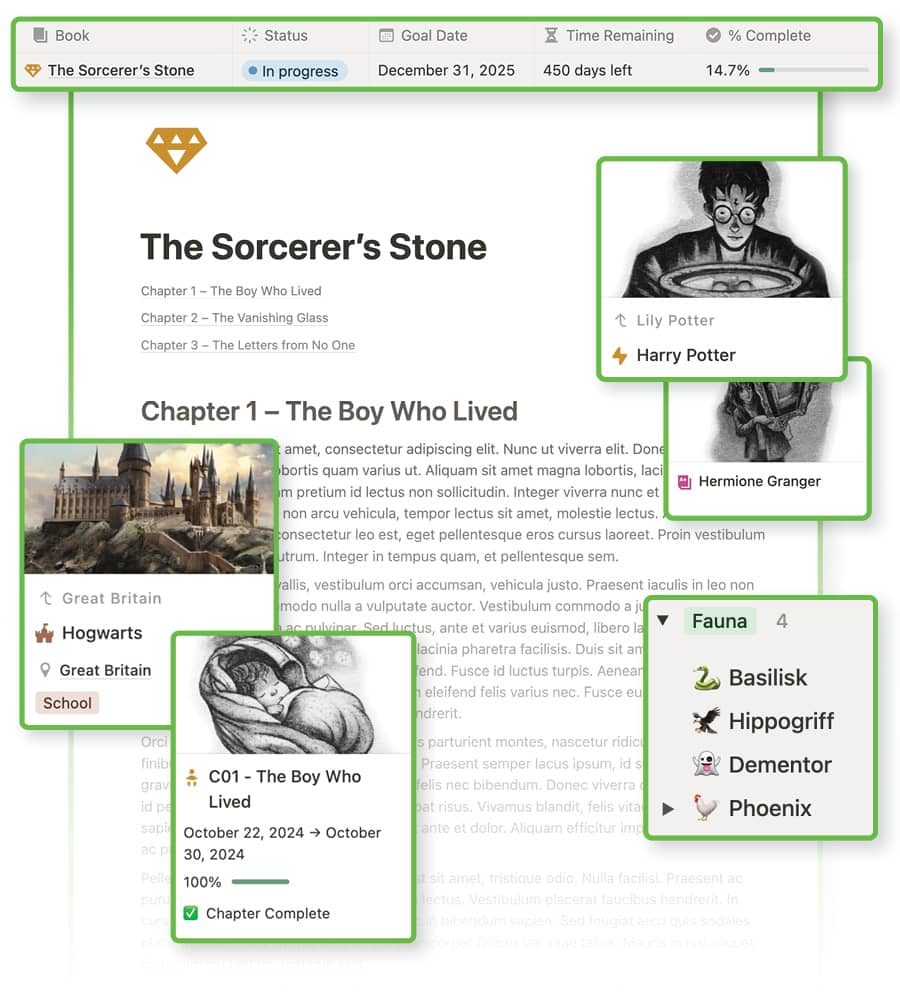
All of that has to live somewhere outside your head. What your character wants, fears, and believes across every scene before the payoff is more than any one writer keeps straight by memory.
All of that has to live somewhere outside your head. What your character wants, fears, and believes across every scene before the payoff is more than any one writer keeps straight by memory.
Most writers don't have a writing problem. They have an organization problem. The Storyteller OS is the Notion system I built to fix that — one place for every character, plot thread, world detail, and scene so seeds and payoffs stay connected from act one to the reveal. See what's inside the Storyteller OS.
Want a deeper look at how it's built? Read how I built the Storyteller OS.
Contents