Gain the storytelling clarity you seek by having all your notes in one connected system — Meet the Storyteller OS.

A Case for Looser, Lived-In Magic Instead of Rigid Rule Systems
The tighter your magic rulebook, the deader the magic. What historians know that worldbuilders forgot.

Written by Kevin Barrett
share




🔥 Why this guide exists
No mind was built to hold an entire novel at once. StoryFlint turns the chaos in your head into a story you can see and control — frameworks to order your thinking, and the Storyteller OS to order your project. Bring us the mess.
share
Somewhere along the way, we started building magic systems like we were filing a patent.
Hard rules. Fixed costs. A neat little equation where mana goes in and fireballs come out.
It's tidy and consistent. And it's quietly draining the magic out of magic.
The rulebook advice was good. We just overcooked it.
Brandon Sanderson set the bar with Mistborn, and as the breakdown in How to Write Great Magic lays out, the rules need to make sense, the limits need to be interesting, and the whole thing has to grab the reader's imagination.
Adrian Tchaikovsky put it bluntly too in his talk How to Write Absurdly Well: if magic has no price, why does anyone in the story have a problem?
He points to Moorcock's End of Time, where near-godlike beings can conjure anything they want and spend the whole series bored out of their minds. No cost, no story.
Good advice. But somewhere we heard "give magic limits" and built a tech tree instead.
Open your magic notes. If you've got more tiers and numbers than you've got reasons anyone fears or wants this magic, you've built a tech tree, not a world.
How magic used to be
Real magic was never an energy bar
Here's the part that got me. That whole "magic as a measurable resource" model traces back to basically one guy.
An Anglican missionary named Codrington described mana in 1891 as a free-floating power you could hold and spend. Durkheim ran with it.
Larry Niven dropped it into fiction in 1969, and now it lives in every RPG you've ever played.
Except linguists later showed mana wasn't a substance at all. It was closer to a verb meaning "to be effective." Your "this spell costs 30 mana" instinct is built on one missionary's flattened misreading.
Every fireball you've ever budgeted for traces back to a clergyman who fumbled a translation. That's the real price of magic.
Find where your magic "runs out" like a battery. Replace that meter with a reason it works or fails here: skill, permission, timing, relationship. Then delete the number.
📖 How to Worldbuild for Emotion, Not Just Detail — Why the details that matter are the ones that carry feeling, not the ones filling a spreadsheet.
Magic was morally fluid, and authority called the shots
In the real world, magic wasn't sorted neatly into good and evil. The moral value lived in who got to interpret it.
John Chrysostom condemned pagan amulets as demonic, then blessed the gospel codex and the sign of the cross as protection. Same protective logic. Different authority. Scholar David Frankfurter calls this the "ambiguous sphere of ritual," where the line between blessing and sorcery is always up for negotiation.
For your world, that means the difference between a saint and a witch might just be who is holding the title.
Pick one ritual in your world and decide who gets to call it holy and who gets to call it witchcraft. Congratulations, you just built politics into your magic.
Nobody was a "wizard." They had day jobs.
There was no class of people called magicians. No guilds. No schools with house colors.
Ritual knowledge was scattered across ordinary trades. Scribes, midwives, stonemasons, gem cutters, and clergy all practiced what we would call magic as a side dimension of their actual work. A scribe copying psalms might also ink a protective amulet on request.
So your magic doesn't need a tower and a faculty. It can hum quietly underneath the blacksmith, the bookkeeper, and the village healer.
Pick one working character — an innkeeper, a scribe, a midwife — and give them a small ritual they do as part of the job. No robes, no academy. Just competence with a touch of the uncanny.
📖 How to Create a Fantasy World That Your Audience Will Love — A full walkthrough for building a fantasy world where magic grows out of everyday life, not institutions.
What this looks like in the wild
The worlds that feel most alive are the ones nobody fully mapped, magic included.
In a 1969 interview, Frank Herbert said he built Dune on what he refused to explain. The Spacing Guild's origins, the full sandworm lifecycle, the Bene Gesserit mystique.
He wanted readers to keep building the world in their own heads after the last page, like a grinding wheel throwing sparks.
Miyazaki does the same thing in Spirited Away. He never spells out the rules of the spirit world. That mess of gaps is exactly what makes it feel foreign and alive.
Mistborn is the interesting counterweight. Sanderson's rules are airtight, and it works beautifully. The man is essentially running a spreadsheet that shoots metal, and it sings anyway. But notice the trade: his magic earns its wonder through precision. Most of us aren't writing a system that load-bearing, and that's okay.
List everything you've explained about how your magic works. Cross out the three least essential. The gaps you just made are where your reader's imagination moves in.
📖 The One Rule That Makes a World Feel Real — How one small, deliberately chosen detail does more worldbuilding than a hundred you stop to explain.
Your world is a context, not a contract
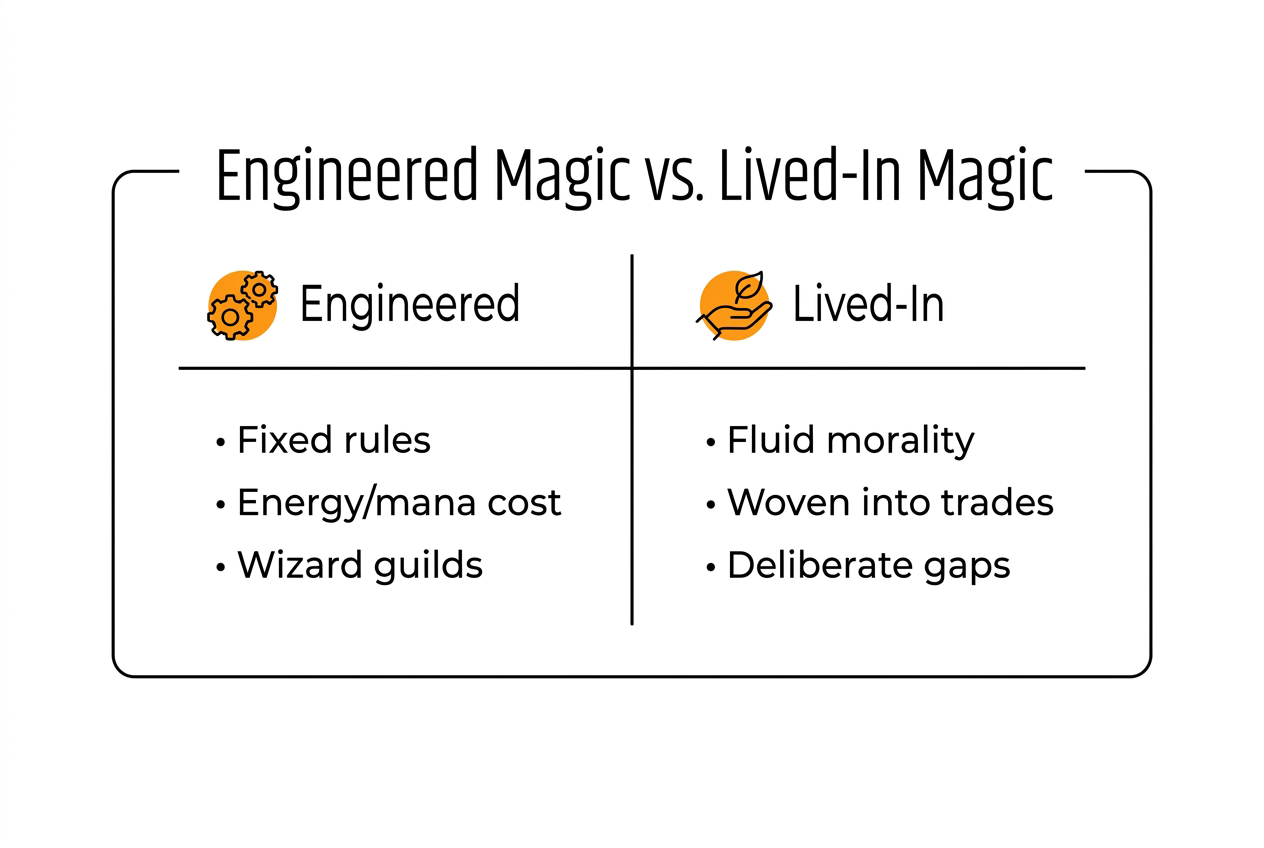
Once you stop treating magic like machinery, the pressure to keep it airtight falls away. N.K. Jemison says it best in her MasterClass: your fictional world is a starting point, not a binding agreement. If a character you love breaks your own rule, change the rule. The story wins.
But here's where lived-in magic turns on you. Three drafts in, you can't remember who was allowed to bless that ritual, which trade carried it, or the rule you swore you'd never break. So you stall out, scrolling back through old chapters, quietly contradicting yourself, watching the world you loved turn into a mess you can't keep straight.
World-building is only useful if you can find it when you need it. That's exactly what the Storyteller OS fixes — it gives your fictional world a home, with every faction, ritual, rule, and the authority behind it organized and connected, so the messy, relational magic you just built stays consistent instead of slipping between drafts.
Build it inside the Storyteller OS.
Want the full breakdown first? Here's how I built the entire system in Notion.
So stop tuning the engine. Let your magic be a little mundane, a little political, and unexplained in the places you never circle back to. That isn't sloppy worldbuilding. That's how magic actually lived.
Contents