Gain the storytelling clarity you seek by having all your notes in one connected system — Meet the Storyteller OS.

How to Build a Searchable Story Bible for TTRPG Campaigns
A TTRPG worldbuilding template in Notion tracks every faction, location, and event so you can answer a player's question in ten seconds, not ten minutes.

Written by Kevin Barrett
share




🔥 Why this guide exists
No mind was built to hold an entire novel at once. StoryFlint turns the chaos in your head into a story you can see and control — frameworks to order your thinking, and the Storyteller OS to order your project. Bring us the mess.
share
The question you can't answer in ten seconds
A player asks about the merchant faction you invented four sessions ago.
You remember the name. You do not remember who they hate, what city they run, or which NPC you tied to them in your Notion notes.
So you scroll. Four players watch you scroll. One of them starts rolling dice for no reason. The world you spent months building just went quiet at the exact moment it needed to speak.
Game writers and GMs carry the novelist's continuity problem at higher difficulty. A novelist can stop writing and dig for twenty minutes. You get about ten seconds before the table loses the thread.
Game writers face the same clock with a bigger crew. The same question arrives from a whole production team.
Why your notes app keeps losing the race
Most campaign prep lives in one long document. Documents store words in the order you typed them, not in the order you need them.
Some GMs move to a wiki. Wikis answer questions you already knew to ask, because someone has to write and link each page by hand. Great system, assuming you enjoy building an encyclopedia nobody reads.
Your memory holds session one and drops the shopkeeper from session nine.
All three fail the same way. They treat a living world as a pile of text.
The databases that do the retrieving
Places that carry their own address

I build this into the World Building Bible, my Notion system for holding an entire story world in one place. Its Locations database uses Parent and Children self-relations. A place can sit anywhere from Continent down to Road, River, or Wilderness.
Then a formula walks the chain upward and shows the full geographic context of any location. You always see where a tavern sits without clicking through four parents.
That pattern works for any hierarchy in Notion, not just maps.
Here is the pull in practice. You open the tavern and the whole chain above it comes along: the road, the city, the region, the continent. The records did the assembling while you slept.
Time your world actually uses

Two small companion databases handle the clock: Eras and Months. They let you define your own time system instead of borrowing the Gregorian calendar.
Once eras and months exist as records, every event gets dated in the world's own terms and sorts chronologically. Most worldbuilding setups miss this piece, and a fictional history quietly defaults to real-world dating. Nothing breaks a dark fantasy faster than a Tuesday in March.
For a GM, that sort order is the answer to "when did that happen".
RJ stopped losing the thread
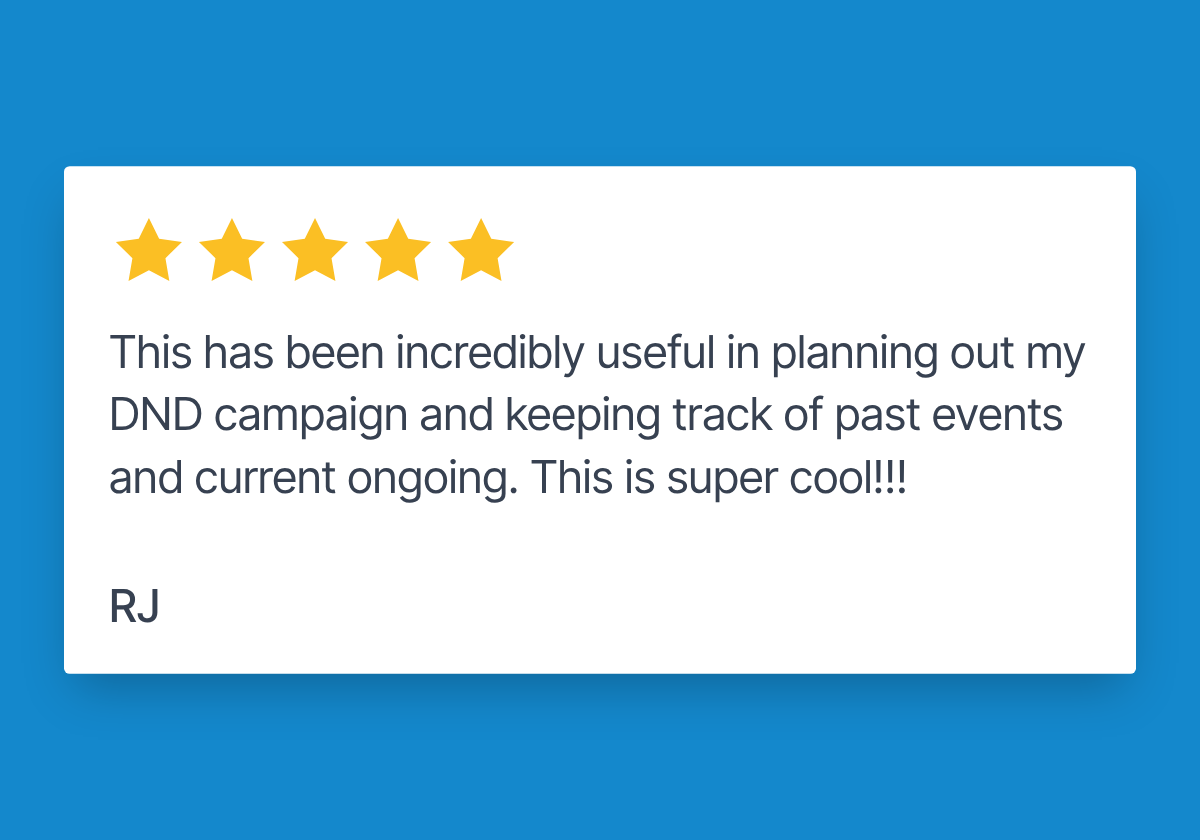
RJ ran a D&D campaign on the World Building Bible and put it plainly in July 2024.
This has been incredibly useful in planning out my DND campaign and keeping track of past events and current ongoing.
Past events and current ongoing. That is the whole job. Not prettier lore, faster recall.
The shift shows up in your prep too. Prep turns into linking new records instead of rereading old ones to find out what you decided.
Try this on your own campaign tonight
Pick one faction from your current game. Set a ten-second timer. Find its home city, its rival, and the last event it caused.
If you beat the clock, your notes work. Keep them.
If you lose, the fix starts small. Give factions, locations, NPCs, events, and world rules their own records. Then link them once.
Link only what has already come up at the table. The rest of the world waits until a player points at it. One evening of linking pays you back all season.
But one evening of linking still means building the records yourself, and you'll find that out around midnight before your next session. The World Building Bible is the Notion system I build for exactly that. Every faction, location, NPC, event, and world rule arrives with its own connected record, so the answer is one click away while four players wait. Grab the World Building Bible.
Your players will ask about that merchant faction again. Answer before they finish the question.
FAQs
Contents